Sleep for College Students: A No-BS Guide
All-nighters don't work. Here's what actually does — the sleep science that matters for exams, mental health, and surviving a dorm.
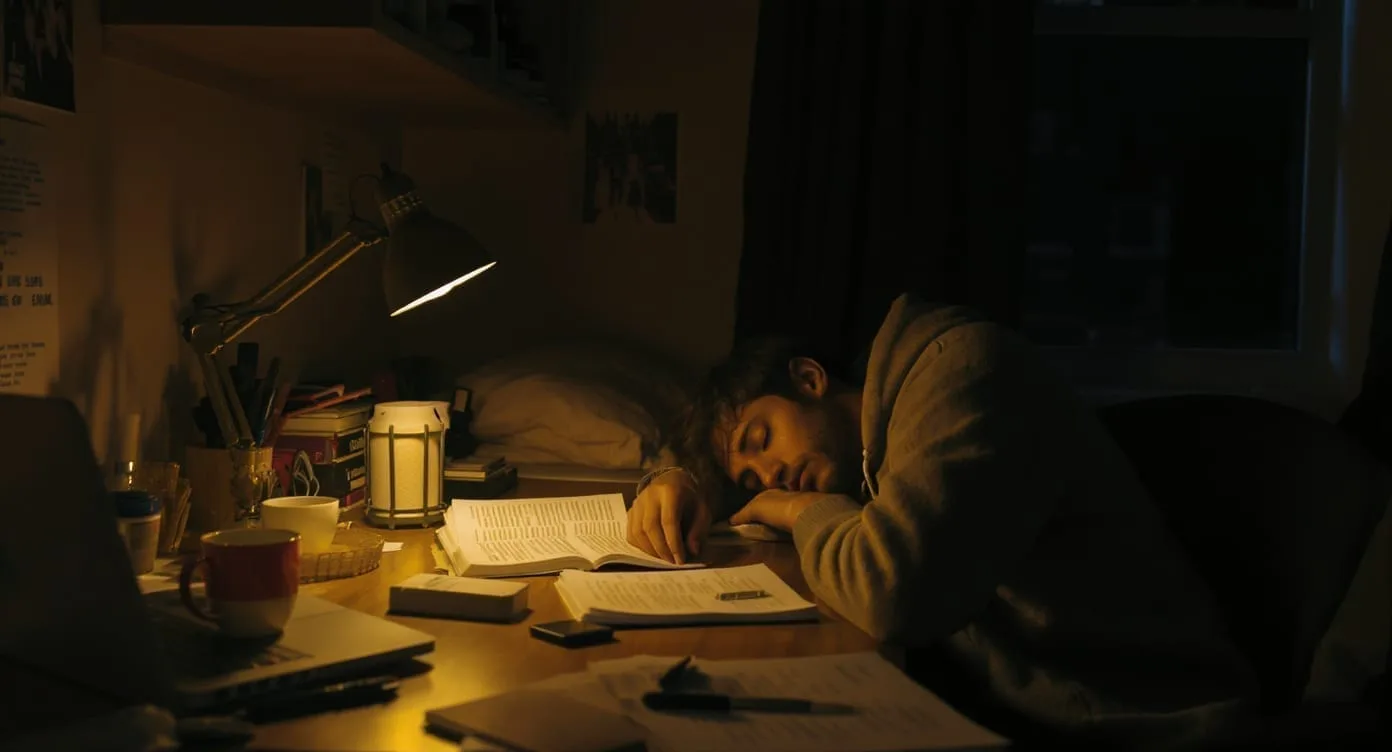
College is where most people's sleep habits go from "imperfect" to "actively self-destructive." Late-night studying, irregular schedules, shared rooms, social pressure to stay up, caffeine dependence, alcohol on weekends, and early classes combine into a system that is specifically hostile to sleep.
The research is clear: most college students are severely sleep-deprived, and the academic, mental health, and physical consequences are measurable and significant. This guide covers the sleep science that actually matters for students — not idealized advice from people who haven't lived in a dorm, but practical strategies that work within the reality of college life.
The problem, in numbers
Why all-nighters don't work
This is the single most important thing in this guide, so let's lead with it.
All-nighters feel productive. You put in 6 extra hours of study that you wouldn't have gotten otherwise. But the research on sleep deprivation and academic performance tells a consistent story: the material you cram during an all-nighter is retained poorly, and the cognitive impairment the next day undermines your exam performance by more than the extra study helps.
Here's why:
Memory consolidation happens during sleep
The process of converting short-term memories (what you studied tonight) into long-term memories (what you'll remember on the exam) happens primarily during REM and deep sleep. Without sleep, the consolidation process is incomplete. You studied the material, but it didn't "stick."
A 2019 study by Okano et al. at MIT tracked student sleep using wearables and correlated it with academic performance. Students who slept more in the days before an exam performed better — even controlling for total study time.
Cognitive function degrades dramatically
After 24 hours without sleep, cognitive performance drops to the equivalent of a blood alcohol concentration of 0.10% — above the legal driving limit in every state. Reaction time, working memory, attention, and logical reasoning all decline. You're taking your exam with a drunk brain.
The better strategy
The dorm problem
Dorms are anti-sleep environments by design: shared rooms, thin walls, unpredictable noise, overhead lighting you can't control, and a social culture that treats 2 AM as mid-evening.
What you can control
Noise:
- Earplugs are the cheapest, most effective dorm sleep tool. Loop Quiet for comfort, Mack's Slim Fit for maximum blocking. See our earplugs roundup.
- A white noise machine or app masks intermittent noise (hallway conversations, slamming doors, your roommate's keyboard) with consistent sound. The Yogasleep Dohm is the go-to.
- Combine both: earplugs cut the peaks, white noise fills the valleys.
Light:
- A sleep mask blocks your roommate's desk lamp, hallway light under the door, and the phone glow from the other bed. See our Manta review.
- If you control any lights, switch to warm-toned bulbs and use a desk lamp instead of overhead lights after 9 PM.
Temperature:
- Dorms are often too warm. A small fan helps with both cooling and noise masking.
- Light sleepwear and a lighter blanket beat trying to cool the whole room.
What you can't control (and how to cope)
- Your roommate's schedule: have the conversation early in the semester. Agree on quiet hours. Use headphones + mask + earplugs when schedules don't align.
- Fire alarms at 3 AM: you can't prevent these, but you can fall back asleep faster with a consistent routine that your brain re-enters quickly.
- Weekend noise: Friday and Saturday nights in a dorm are loud. Earplugs + white noise + sleep mask is the triple combo.
The schedule problem
College schedules are irregular by nature: Monday classes at 8 AM, no Tuesday class until noon, Thursday night study group until midnight. The circadian system hates this — it wants consistency.
The one-anchor rule
You can't control every night's bedtime. But you can control one thing: wake up at the same time every day, including weekends. This anchors your circadian rhythm even when bedtimes vary.
Pick the earliest time you ever need to be awake (usually your earliest class time minus commute/prep). Set that as your daily wake time. On days without early classes, wake at the same time and use the extra morning for exercise, studying, or leisure.
Strategic napping for students
Unlike people with insomnia (who shouldn't nap), students with irregular schedules can use naps to supplement insufficient nighttime sleep:
- 20-minute nap between classes: restores alertness without entering deep sleep
- 90-minute nap in the afternoon: a full cycle that includes REM — good for memory consolidation before an evening study session
- Never nap after 4 PM: it reduces the sleep pressure you need at bedtime
Caffeine: the student's crutch
Coffee, energy drinks, and pre-workout are universal on campus. Caffeine works — it blocks adenosine and restores alertness. But it has a 5-hour half-life, and students consistently underestimate how late-day caffeine affects their nighttime sleep.
The student caffeine rule:
- Coffee or energy drinks before noon: fine
- After noon: switch to tea (lower caffeine) or water
- After 4 PM: nothing caffeinated, period
- That 10 PM Red Bull before a study session? It's still 50% active at 3 AM
Use our caffeine cutoff calculator for your specific timing.
Alcohol: the weekend reality
Weekend drinking is part of college life for many students. From a sleep perspective:
- Alcohol helps you fall asleep but fragments the second half of the night and suppresses REM
- The "hangover sleep" you get the next day is low-quality — light, fragmented, and non-restorative
- Two drinks, finished 3+ hours before bed, produces minimal sleep disruption
- Five drinks at midnight produces catastrophic sleep architecture for the entire night and the following day
You don't need to be a teetotaler. You do need to know that a heavy Friday night takes until Monday to fully recover from — and that your Sunday study session is happening on a brain that's still impaired. See our alcohol and sleep guide for the full breakdown.
Mental health and sleep
Sleep and mental health are deeply interconnected in the college population:
- Depression: insomnia is both a symptom and a risk factor. Students who sleep poorly are significantly more likely to develop depression.
- Anxiety: anxiety-driven insomnia is the most common sleep complaint among college students. See our anxiety and sleep guide.
- ADHD: undiagnosed ADHD is common in college and often co-occurs with sleep problems (delayed sleep phase, difficulty winding down).
If your sleep problems feel bigger than "I stay up too late" — if they're persistent, distressing, or accompanied by mood changes — use your campus counseling center. Most offer free or low-cost sessions, and many have experience with sleep-specific issues.
The minimum viable sleep plan for students
If you do nothing else from this guide, do these three things:
- Same wake time every day — including weekends. Pick one and stick to it for 2 weeks.
- Earplugs + sleep mask — total investment: $30. Transforms dorm sleep.
- No caffeine after 2 PM — use the morning coffee, skip the evening energy drink.
These three changes, consistently maintained, will improve your sleep more than any supplement, app, or expensive gadget.
Frequently asked
Is it better to sleep 4 hours or pull an all-nighter?+
I can't fall asleep before midnight. Am I broken?+
Do blue-light glasses help for late-night studying?+
Should I use a sleep app?+
My roommate snores. What do I do?+
References
- Okano K et al. Sleep quality, duration, and consistency are associated with better academic performance in college students. NPJ Science of Learning, 2019.
- Lund HG et al. Sleep patterns and predictors of disturbed sleep in a large population of college students. Journal of Adolescent Health, 2010.
- Becker SP et al. Sleep in a large, multi-university sample of college students: sleep problem prevalence. Sleep Health, 2018.
- Curcio G et al. Sleep loss, learning capacity and academic performance. Sleep Medicine Reviews, 2006.
Where to go next
- The science of napping
- Caffeine and sleep
- Best earplugs for sleeping
- Best sleep gear for college students
Related findings.
 Protocol
Why You Wake Up at 3 AM (And What You Can Do About It)
Middle-of-the-night wake-ups have a small set of common causes — and most of them are addressable. A writer-curated look at what's really happening at 3 AM.
 Protocol
Why We Dream: What Science Actually Knows (and Doesn't)
Dreams aren't random noise. Published neuroscience points to specific functions — memory, emotion, creativity. Here's what we know and what's still a mystery.
 Protocol
Sleep for Shift Workers: A Survival Guide
Night shifts fight your biology. Here's what published research says about managing sleep when your schedule won't cooperate.