How to Beat Jet Lag Fast: A Research-Backed Protocol
Jet lag isn't inevitable. Published circadian research points to a specific protocol — light timing, meal timing, and optional melatonin — that cuts recovery in half.
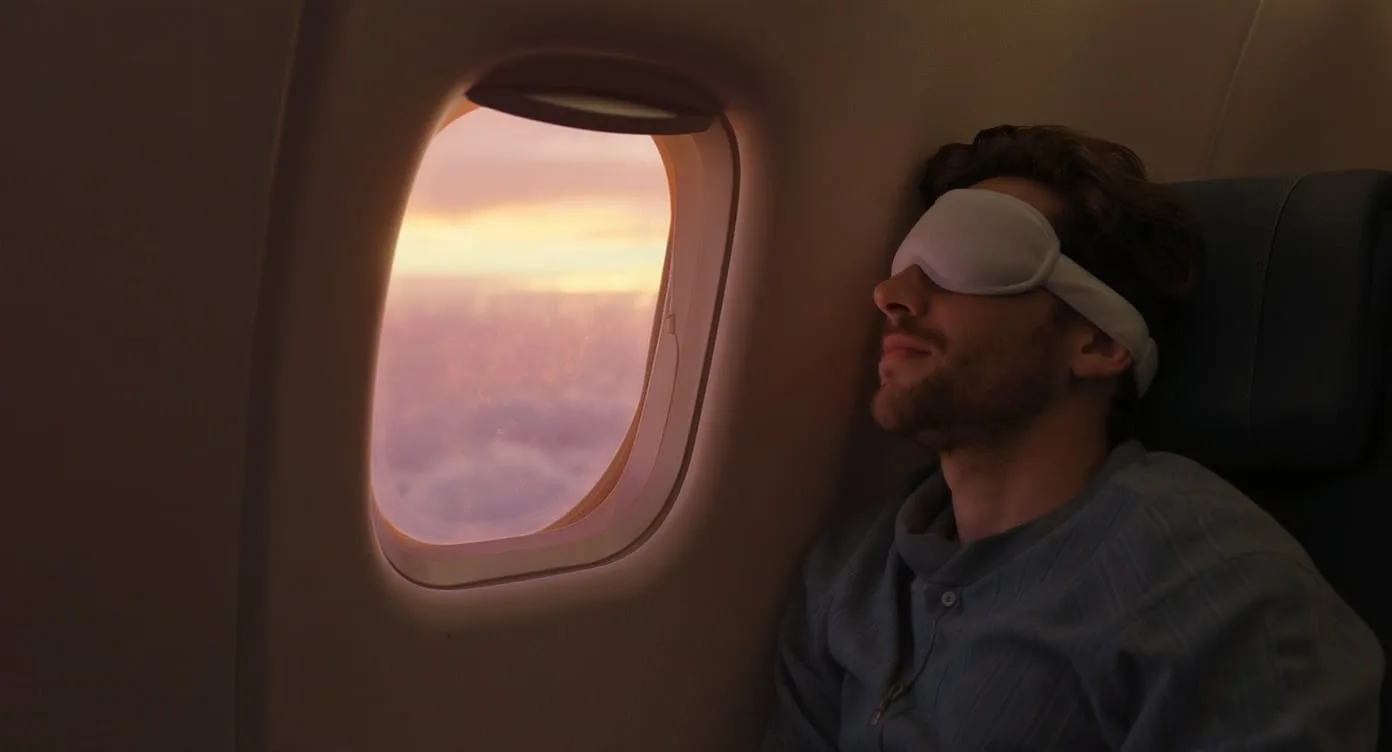
Jet lag is a circadian rhythm disruption caused by rapid travel across time zones. Your internal clock — set by light, meals, and activity — is suddenly misaligned with the local environment. The result: you're exhausted when everyone is awake, wide-eyed at 3 AM, and your digestion, mood, and cognition are all off for days.
The good news: jet lag follows predictable rules, and the research on circadian shifting gives us a specific protocol that can cut recovery time roughly in half. This guide covers the science, the protocol, and the common mistakes that make jet lag worse.
How jet lag works
Your suprachiasmatic nucleus (SCN) — the master circadian clock — adjusts to a new time zone at a rate of roughly 1 hour per day without intervention. A 6-hour time zone shift (New York to London) therefore takes about 6 days to fully adjust to naturally.
Two key asymmetries:
- Eastward travel is harder than westward. Flying east requires advancing your clock (going to bed earlier), which is harder than delaying it (going to bed later). This is because the human endogenous circadian period is slightly longer than 24 hours (~24.2h), so delaying is more natural than advancing.
- More time zones = more recovery. The relationship is roughly linear up to about 8–9 time zones, after which some people find it easier to adjust by delaying rather than advancing (going the "long way around").
The protocol: before, during, and after the flight
2–3 days before departure
Shift your schedule toward the destination time zone:
- Traveling east: go to bed and wake up 30–60 minutes earlier each day
- Traveling west: go to bed and wake up 30–60 minutes later each day
This pre-shift doesn't eliminate jet lag, but it reduces the gap your clock needs to bridge after arrival. Even a 1–2 hour pre-shift helps.
Adjust light exposure:
- Traveling east: get bright light in the early morning, avoid bright light in the evening
- Traveling west: get bright light in the late afternoon/evening, avoid bright light in the early morning
During the flight
- Set your watch to the destination time zone as soon as you board. Start thinking in destination time immediately.
- Sleep on the plane if it's nighttime at your destination. Use a sleep mask, earplugs, and neck pillow. Avoid sleeping if it's daytime at your destination.
- Stay hydrated. Cabin air is 10–20% humidity. Dehydration worsens jet lag symptoms.
- Avoid alcohol. It dehydrates, fragments sleep, and impairs circadian adjustment.
- Caffeine strategically. Use it to stay awake if it's daytime at your destination. Avoid it if you need to sleep.
After arrival: the critical 48 hours
This is where the protocol matters most. The two most powerful tools are timed light and timed darkness.
Traveling east (clock needs to advance):
- Morning: get outside in bright sunlight as soon after local dawn as possible. This is the single most important action. Even 15–20 minutes advances the clock significantly.
- Evening: dim lights early. Wear blue-blocking glasses if you can't control ambient lighting.
- Avoid bright light in the late evening and early night at the destination — this will delay your clock (the opposite of what you want).
Traveling west (clock needs to delay):
- Evening: get bright light exposure in the late afternoon and early evening at the destination.
- Morning: avoid very bright light in the early morning for the first 2–3 days (wear sunglasses if you're out early).
- This is counterintuitive — you'd think morning light always helps. But after westward travel, early morning light hits the wrong side of your phase response curve and can actually advance your clock when you need to delay it.
Optional: timed melatonin
Melatonin can accelerate circadian shifting when used correctly:
Traveling east:
- Take 0.5–1mg of melatonin at the destination's bedtime (or 30 minutes before) for the first 3–4 nights after arrival.
- This signals "darkness" to your clock at the new local time, reinforcing the advance.
Traveling west:
- Melatonin is less useful for westward travel (delaying is natural). If used, take it in the early morning hours at the destination — but most people don't need it. Talk to a doctor before using melatonin, especially if you take other medications.
Meals and exercise as secondary levers
Meal timing
Your peripheral clocks (in the liver, gut, and other organs) respond to meal timing. Eating on the destination's schedule — even if you're not hungry — helps align these peripheral clocks faster.
- Eat breakfast at local breakfast time, even if it's 3 AM on your home clock.
- Avoid heavy meals during your home-clock nighttime (this signals daytime to your gut).
Exercise
Exercise is a weak zeitgeber (circadian time-setter) compared to light, but it reinforces the shift. Morning exercise at the destination adds to the morning-light signal. Avoid intense evening exercise during the adjustment period — it can increase core temperature and arousal when you need to wind down.
The flight direction cheat sheet
| | Eastward (advance) | Westward (delay) | |---|---|---| | Pre-trip | Sleep earlier by 30-60 min/day | Sleep later by 30-60 min/day | | Morning light | Seek it (crucial) | Avoid early (first 2-3 days) | | Evening light | Avoid bright light | Seek it (late afternoon) | | Melatonin | 0.5-1mg at destination bedtime | Usually not needed | | Meals | Eat on destination schedule | Eat on destination schedule | | Recovery time | ~1 day per time zone (with protocol) | ~0.5-0.7 days per zone |
Common mistakes
Napping too long on arrival day
A 20-minute nap to take the edge off is fine. A 3-hour nap destroys your sleep pressure and guarantees a terrible first night. If you arrive exhausted, push through to local evening (with caffeine if needed), then go to bed at a reasonable local time.
Relying on sleeping pills
Sleep medication can help you sleep on the plane or on the first night, but it doesn't shift your circadian clock. You wake up rested but still misaligned. Timed light is what actually fixes jet lag; pills just manage one symptom.
Staying indoors
Hotel rooms and conference centers are dim compared to outdoor light. The most effective thing you can do on arrival day is spend time outside — eating, walking, sightseeing. Indoor light isn't bright enough to shift the clock efficiently.
Using alcohol to sleep at the destination
Alcohol sedates but fragments sleep architecture, suppresses REM, and dehydrates — all of which compound jet lag rather than resolving it. See our alcohol and sleep guide.
Specific scenarios
Short trips (1-2 days)
If you're only at the destination for 1–2 days, consider not adjusting. Stay on your home time zone: eat, sleep, and work at your home-clock times. This avoids the adjustment pain and avoids the re-adjustment pain when you return. It only works for short trips and mild time zone differences (2–4 hours).
Red-eye flights
Red-eyes are eastward flights where you "lose" a night. The key: sleep as much as possible on the plane (mask + earplugs + melatonin), get bright morning light on arrival, and push through the first day without napping.
Frequent flyers
People who travel across time zones weekly (pilots, flight attendants, international business travelers) face chronic circadian disruption. The long-term health effects mirror those of shift work: elevated cardiovascular risk, metabolic disruption, and mood effects. There's no perfect solution — but the protocol above, applied consistently, reduces the cumulative damage.
Frequently asked
How many time zones before jet lag matters?+
Does direction matter more than distance?+
Can I take melatonin on the plane?+
Do 'jet lag diets' work?+
How do flight attendants cope?+
References
- Eastman CI, Burgess HJ. How to travel the world without jet lag. Sleep Medicine Clinics, 2009.
- Herxheimer A, Petrie KJ. Melatonin for the prevention and treatment of jet lag. Cochrane Database of Systematic Reviews, 2002.
- Waterhouse J et al. Jet lag: trends and coping strategies. The Lancet, 2007.
- Sack RL. Jet lag. New England Journal of Medicine, 2010.
Where to go next
Related findings.
 Protocol
Why You Wake Up at 3 AM (And What You Can Do About It)
Middle-of-the-night wake-ups have a small set of common causes — and most of them are addressable. A writer-curated look at what's really happening at 3 AM.
 Protocol
Why We Dream: What Science Actually Knows (and Doesn't)
Dreams aren't random noise. Published neuroscience points to specific functions — memory, emotion, creativity. Here's what we know and what's still a mystery.
 Protocol
Sleep for Shift Workers: A Survival Guide
Night shifts fight your biology. Here's what published research says about managing sleep when your schedule won't cooperate.