Manta Sleep Mask Review: An Verified Buyer Report
What thousands of verified buyers say about the Manta Sleep Mask — the eye-cup design, the blackout claims, and who it's actually built for.
The Manta Sleep Mask takes a fundamentally different approach to eye masking than most products in the category. Instead of a flat strip of fabric pressed against your face, it uses adjustable, padded eye cups that create a light-blocking seal around each eye individually. The result, according to the vast majority of verified buyers, is a genuinely darker sleep environment with none of the eyelid pressure, lash friction, or nose-gap light leaks that plague traditional flat masks.
This review synthesizes patterns from thousands of verified buyer reviews across Amazon, the Manta website, and independent review platforms, plus the design details and materials specs worth knowing before you decide to buy.
Manta Sleep
Manta Sleep Mask
$35.00
Pros
- Adjustable eye cups for total blackout
- Zero pressure on eyelids
- Modular and machine washable
Cons
- Bulkier than flat masks
- Strap can loosen over months of heavy use
How it works
The Manta uses a modular three-part design:
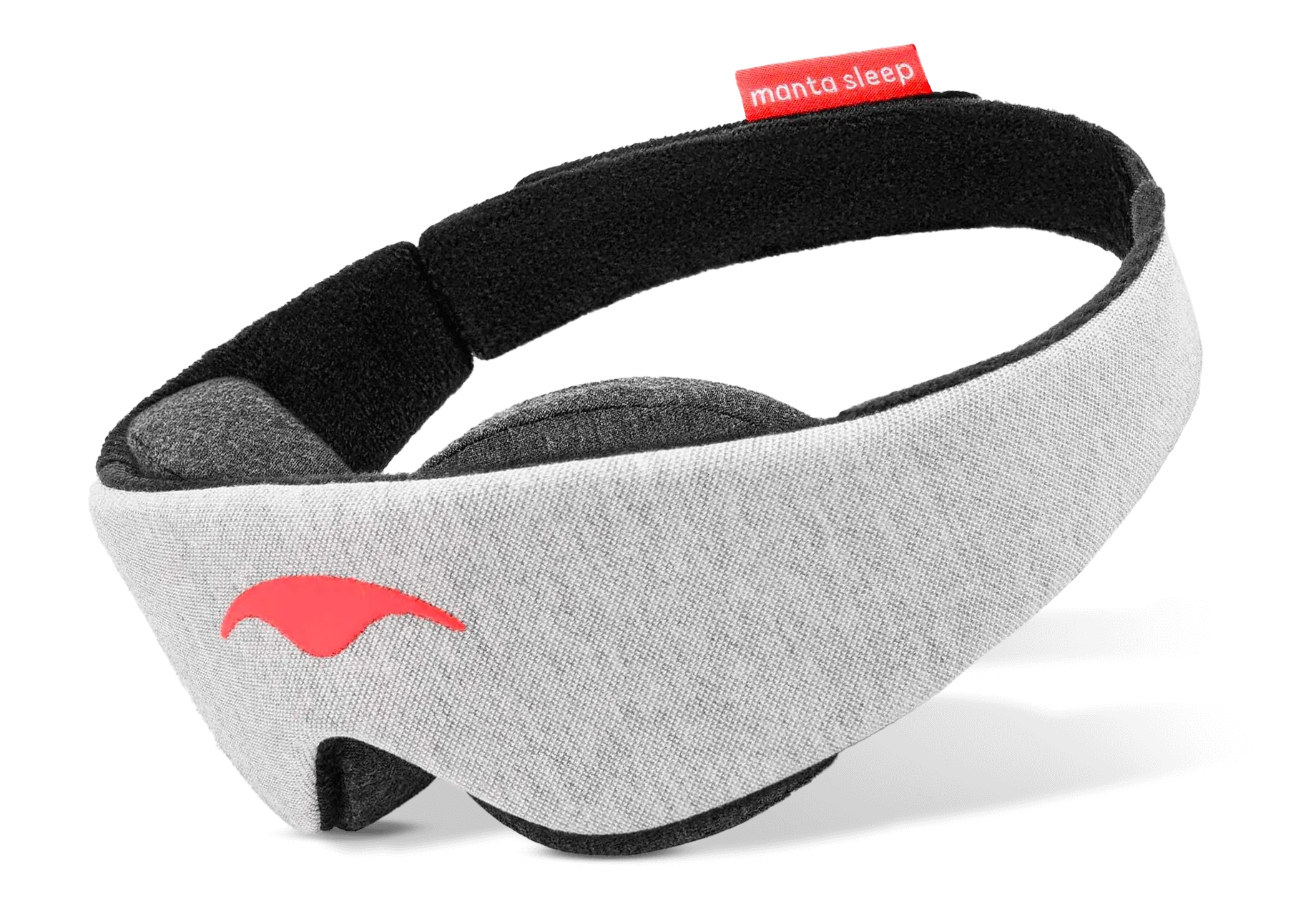
- A fabric headband. This wraps around your head and provides the anchor point. The band is wider and softer than most sleep mask straps, distributing pressure more evenly.
- Two separate eye cups. Each cup attaches to the headband via a Velcro-like adhesive, letting you adjust the position laterally, vertically, and rotationally to match your unique facial geometry. The cups are contoured inward, so they block light around the perimeter without touching your eyelids.
- Foam padding. The edge of each cup is lined with a soft foam that conforms to the skin around your eye socket, creating a light seal.
The system works because it treats each eye independently. Most flat masks fail because faces aren't symmetrical — one eye socket is slightly higher or deeper than the other, the bridge of the nose creates a gap that lets light in, and the mask fabric inevitably presses on the eyelids. The Manta's eye cups avoid all three of these problems.
What buyers consistently praise
True blackout
This is the #1 cited benefit in positive reviews, and it appears across every platform and review platform we surveyed. Buyers routinely compare the darkness level favorably against blackout curtains, and several reviewers describe it as "the darkest I've ever experienced while sleeping."
The specific design advantage is at the nose bridge — the area where most flat masks leak light. The eye cups create a seal around each eye that extends down to the bridge, closing the gap that other masks can't address.
This matters for sleep quality because even small amounts of ambient light hitting the retina during sleep can suppress melatonin production and fragment sleep architecture. Published research suggests that sleeping in a room with light levels above ~3 lux (roughly the brightness of a dimmed hallway light) is associated with measurable impacts on sleep depth and cardiovascular markers. A mask that eliminates all retinal light exposure — not just most of it — is operating in a different category from one that merely reduces brightness.
Zero eyelid pressure
This is the second most-mentioned feature. Because the eye cups are concave, nothing touches your eyelids or eyelashes while you wear the mask. Several categories of buyers highlight this specifically:
- Side sleepers whose face presses into a pillow, which pushes a flat mask into their eyes.
- People with sensitive eyes or recent eye surgery who can't tolerate pressure.
- People who dislike the "trapped" feeling of a flat mask tight against their face.
- REM sleep quality. Some buyers speculate (plausibly, though without direct evidence) that allowing the eyes to move freely during REM sleep may improve dream recall or subjective sleep quality.
Modular, washable design
The cups, headband, and padding are all separable and machine washable. Long-term reviewers (6+ months of ownership) consistently mention this as a durability advantage over cheaper masks that absorb oils and degrade after a few months. Several mention replacing only the padding (Manta sells replacement parts) rather than the entire mask.
What buyers consistently mention as drawbacks
Bulk
The Manta is significantly bulkier than a flat fabric mask. If you travel with a small toiletry kit or dopp bag, it takes up real space. Several reviewers who love the mask at home specifically say they pack a cheaper, flatter mask for travel.
Adjustment learning curve
Getting the eye cups positioned correctly takes 2–5 nights of fine-tuning for most people. The flexibility is the product's strength, but it means the out-of-box experience involves some trial and error — moving cups up, down, closer together, further apart — before the seal is right. Reviewers who give up before getting the fit right are a common source of 2-star reviews.
Strap stretch over time
A subset of reviews from owners past the 6-month mark mention the headband elastic loosening and needing periodic adjustment or tightening. Manta sells replacement straps, but some buyers expect the original to last longer at the price point.
Price
At ~$35, the Manta is 3–5x the price of basic fabric masks. Most positive reviewers acknowledge this but describe the value as justified by the blackout quality and durability. Most negative reviewers cite it as part of a broader dissatisfaction (usually related to fit issues).
Who it's for
How it compares to alternatives
vs. basic flat masks ($5–$15)
Flat masks are cheaper and pack smaller. They're adequate for occasional use, travel, or people who sleep on their backs in already-dark rooms. But they almost universally leak light at the nose, press on the eyelids, and degrade quickly with daily use. If you're a nightly user, the Manta's design solves all three of these problems.
vs. contoured foam masks ($10–$20)
Contoured masks (like the popular Nidra or Alaska Bear brands) address the eyelid-pressure issue with a molded plastic shell, but they still use a single piece over both eyes. Light leakage at the nose bridge remains common, and the fixed shape doesn't accommodate asymmetric faces. The Manta's independent eye cups are the specific innovation that differentiates it from this tier.
vs. weighted sleep masks ($25–$50)
Weighted masks (like the Nodpod or similar) provide gentle pressure around the eyes, which some users find calming. They're an entirely different product concept — the weight is the feature, not the blackout. If you want deep pressure therapy, consider a weighted mask. If you want maximum light blocking with zero pressure, the Manta is the opposite approach.
vs. blackout curtains
If your bedroom is light-polluted, a sleep mask is a personal solution; blackout curtains are a room-level solution. Both work. The advantage of curtains is they also cool the room slightly (thermal insulation) and provide privacy. The advantage of a mask is portability and partner-independence (your partner can read with a lamp while you sleep in full darkness).
For most people, combining both — blackout curtains plus a mask — is the "belt and suspenders" approach that provides the most complete light control.
Where to buy
Frequently asked
Will it block out light from a partner's reading lamp?+
Does it work for side sleepers?+
Is it safe for daily use?+
Can I wear it with a CPAP mask?+
How long does it take to adjust to sleeping with a mask?+
References
- Cho JR et al. Effects of artificial light at night on human health: a literature review. Chronobiology International, 2015.
- Obayashi K et al. Bedroom light exposure at night and the incidence of depressive symptoms. American Journal of Epidemiology, 2018.
Where to go next
- Best blue light blocking glasses
- Optimal bedroom temperature guide
- 12 evidence-based tips for better sleep
Related findings.
 Lab Report
Zinus Green Tea Memory Foam Mattress Review: The $400 Mattress Most People Actually Need
A detailed review of the Zinus 12-Inch Green Tea Memory Foam Mattress — the most-reviewed budget mattress on Amazon, and why it satisfies 80% of sleepers at 25% of the premium price.
Yogasleep Rohm Travel White Noise Machine Review: The Pocket-Sized Sleep Saver
A detailed review of the Yogasleep Rohm — portability, battery life, sound quality, and how it compares to plug-in alternatives.
 Lab Report
Yogasleep Dohm Review: The 60-Year-Old Design That Still Wins
A detailed review of the Yogasleep Dohm — why a real-fan noise machine from 1962 still outsells digital alternatives, and who it's for.