The Optimal Bedroom Temperature for Deep Sleep
Sleep researchers point to a narrow temperature window for deep sleep. Here's the research — and how to hit it.

Of all the variables that affect sleep quality, bedroom temperature is one of the most underrated and one of the easiest to fix. According to most sleep researchers, the temperature of your sleep environment is up there with light exposure as one of the dominant inputs to deep sleep — and unlike most sleep optimizations, it doesn't require willpower, behavior change, or a new bedtime routine. You just set a number.
This guide summarizes what the published research and expert guidelines suggest about bedroom temperature, why it matters more than most people realize, and the most cost-effective ways to hit the recommended range.
Why temperature matters this much
Your body doesn't just "like" a cool room — it actively requires one for optimal sleep. The mechanism is biological and surprisingly precise.
About an hour before your habitual bedtime, your body begins a process called thermoregulatory cool-down. Your core temperature drops by roughly 1°C as your hypothalamus shifts blood flow toward the skin and extremities, dumping heat into the environment. This cool-down is one of the strongest physiological signals that your brain interprets as "time to sleep." If the surrounding environment is too warm to allow that heat dump, the entire cascade is impaired — sleep onset takes longer, deep sleep is reduced, and you're more likely to wake during the night.
This is why the same person can sleep beautifully at 65°F and toss restlessly at 75°F. It's not preference. It's biology.
The recommended range
Most sleep organizations — including the National Sleep Foundation and the American Academy of Sleep Medicine — point to roughly 60–67°F (15.5–19.5°C) as the temperature range associated with the best sleep for the average adult. Individual preference varies, and there are people at both ends of this range who do well, but the consensus midpoint is around 65°F.
Practical signals you're outside the right range:
- Too hot: waking up sweating, kicking off the covers in the middle of the night, fragmented sleep in the second half of the night, lower deep sleep on a wearable.
- Too cold: waking curled into a ball, cold extremities even with covers, difficulty falling asleep because you can't warm up.
The most common direction people are wrong is too hot — particularly in winter when central heating runs all night, and in summer in homes without good cooling.
Cooling levers, ranked by impact
If your bedroom is currently too warm, here are the interventions ranked roughly by effectiveness per dollar.
1. Lower the thermostat (cheapest, most effective)
For most people, simply setting the bedroom thermostat to 65°F overnight is the single highest-leverage intervention. If your house has central heating, an additional vent or smart thermostat schedule can give you a different overnight setpoint than the rest of the house.
2. Use a fan
A simple oscillating fan or ceiling fan moves air across your skin, accelerating heat dump even if the air temperature itself isn't especially low. It also produces white noise as a side benefit. For most people who can't get the room cool enough with the thermostat alone, a $30 fan is the next-best move.
3. Switch to breathable bedding
Heavy synthetic comforters trap heat against your skin. Lighter cotton, linen, or specifically designed cooling sheets allow heat to escape. This is especially important for hot sleepers or people who sleep with a partner whose body heat adds to the load.
4. Cool the surface, not just the air
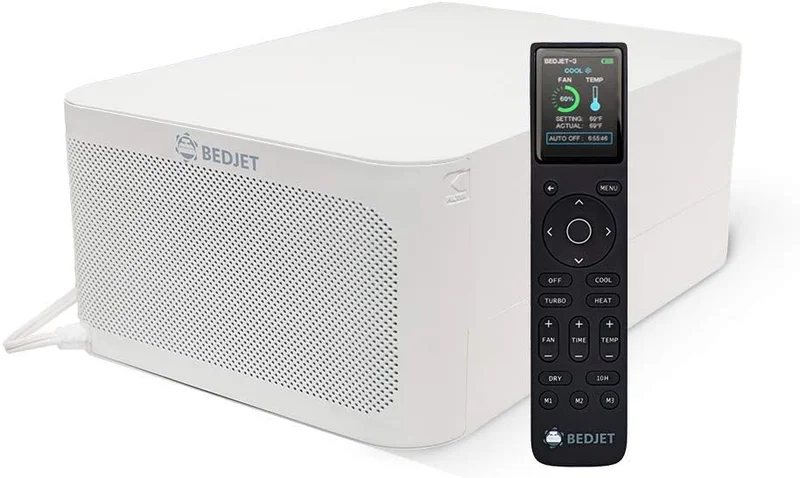
Active cooling systems — like the BedJet 3 or other water-based mattress pads — circulate cool water through tubes under your sheet. They're expensive ($300–$1,000+) but address the variable that matters most for many sleepers: the surface in direct contact with your skin. They're overkill for most people but transformative for hot sleepers or for couples whose temperature preferences don't match.
5. Take a warm shower 60–90 minutes before bed
This sounds counterintuitive — warming yourself up to sleep cooler — but it's well-supported in research. A warm shower dilates blood vessels at the skin surface, which then dump heat rapidly once you're out of the shower. The net effect is a faster, deeper drop in core temperature than you'd get without the shower. A 2019 systematic review found this technique consistently associated with reduced sleep onset latency.
6. Sleep with less
A surprising number of people sleep too warm because they're overdressed for bed. Lighter sleepwear (or none) often does more than expensive cooling tech.
Special situations
When you sleep with a partner who runs a different temperature
This is one of the most common bedroom-temperature complaints, and it has surprisingly few good solutions. The approaches that consistently come up in detailed reviews:
- Dual-zone cooling pads (like the BedJet 3 Dual Zone) let each side of the bed run at independent temperatures. This is the single most-praised solution among thermally mismatched couples.
- Different blankets, with each partner using their own setup. Common in Northern European bedrooms, increasingly popular elsewhere. The classic compromise: thinner blanket for the hot sleeper, heavier for the cold one.
- Compromise the room temperature toward the cooler partner, then have the warmer partner add layers as needed. Adding warmth is much easier than removing heat after the fact.
Hot climates without strong AC
If you live somewhere where ambient temperatures stay above 75°F at night and you can't reliably cool the air, your highest-leverage moves are: a powerful fan, the lightest possible bedding, an active cooling system if budget allows, and a cool shower right before bed. None of these will perfectly compensate for a hot environment, but together they can move things meaningfully closer to the optimal range.
Hot flashes and perimenopause
Hot flashes cause sudden, dramatic temperature shifts that can break sleep architecture even in an otherwise optimal environment. The fixes here often need to be medical, not environmental — talk to a doctor. That said, an active cooling pad can help significantly with the sleep-fragmentation effects of frequent night sweats.
A highly-rated cooling tool
For readers who want to actively cool the surface they sleep on rather than the whole room, the most consistently top-rated option in verified buyer reviews is the BedJet 3 system. We've covered it in depth in our detailed review:
BedJet
BedJet 3 Climate Comfort System
$499.00
Pros
- Active heating and cooling without water tubes
- Wireless remote with programmable sleep schedules
- Available in single-zone and dual-zone for couples
Cons
- Air-based system not as cold as water-based competitors
- Slight fan noise on higher settings
Frequently asked
What if my partner runs hot and I run cold?+
Does cooling actually beat AC?+
How long until I notice a difference?+
Is it worth buying a smart thermostat just for sleep?+
What about heated mattress pads?+
References
- Okamoto-Mizuno K, Mizuno K. Effects of thermal environment on sleep and circadian rhythm. Journal of Physiological Anthropology, 2012.
- National Sleep Foundation. The best temperature for sleep.
- Haghayegh S et al. Before-bedtime passive body heating by warm shower or bath to improve sleep: a systematic review and meta-analysis. Sleep Medicine Reviews, 2019.
- Harding EC, Franks NP, Wisden W. The temperature dependence of sleep. Frontiers in Neuroscience, 2019.
Where to go next
- 12 evidence-based ways to sleep better tonight
- Why you wake up at 3 AM
- BedJet 3 review
- Best bed cooling systems
- Best cooling sheets
Related findings.
 Protocol
Why You Wake Up at 3 AM (And What You Can Do About It)
Middle-of-the-night wake-ups have a small set of common causes — and most of them are addressable. A writer-curated look at what's really happening at 3 AM.
 Protocol
Why We Dream: What Science Actually Knows (and Doesn't)
Dreams aren't random noise. Published neuroscience points to specific functions — memory, emotion, creativity. Here's what we know and what's still a mystery.
 Protocol
Sleep for Shift Workers: A Survival Guide
Night shifts fight your biology. Here's what published research says about managing sleep when your schedule won't cooperate.