BedJet 3 Review: Air-Based Active Cooling for Hot Sleepers
A detailed review of the BedJet 3 — cooling range, fan noise, dual-zone option, and who this air-based climate system is actually worth it for.
The BedJet 3 is an active cooling (and heating) system that pushes temperature-controlled air through a sheet-like attachment between your fitted sheet and top sheet. Unlike water-based systems, there are no tubes or pads to leak — just a compact unit on the floor and an air hose clipped to the bed. Based on verified owner reviews across Amazon and sleep communities, it's one of the most praised interventions for sleepers who genuinely overheat at night.
This review synthesizes what verified buyers consistently report, plus the system's published specs and how they relate to the broader research on sleep and temperature.
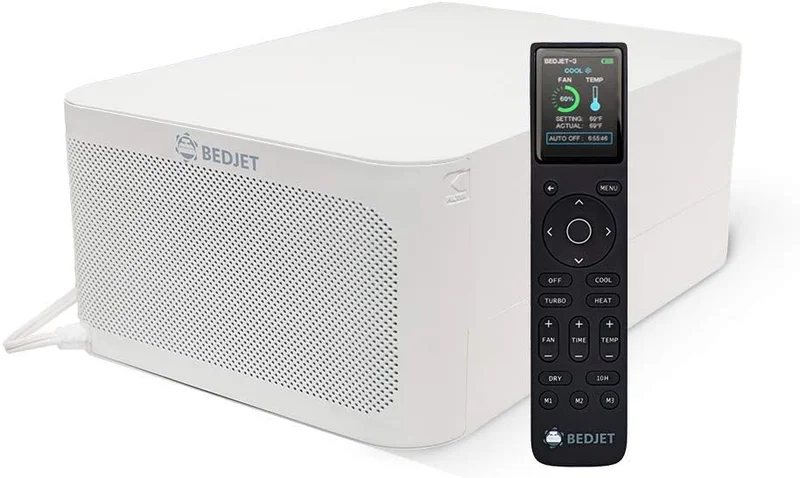
BedJet
BedJet 3 Climate Comfort System
$499.00
Pros
- Active heating and cooling without water tubes
- Wireless remote with programmable sleep schedules
- Available in single-zone and dual-zone for couples
Cons
- Air-based system not as cold as water-based competitors
- Slight fan noise on higher settings
How it works
The BedJet 3 sits on the floor next to your bed. It contains a variable-speed fan and a heating element. An air hose connects the unit to a nozzle that clips to the bottom of your mattress, directing airflow up between your fitted sheet and top sheet — or into an optional "Cloud Sheet" that distributes airflow evenly across the bed surface.
Unlike water-cooled systems, the BedJet does not have a compressor — it cools by pulling ambient room air through the unit and pushing it at high volume across your body, maximizing evaporative cooling. This means two things:
- It can cool effectively as long as the room air is cooler than your body
- It can heat aggressively (up to ~104°F at the nozzle) because heating is easier than refrigeration
Why active cooling matters
Published research — most notably by Okamoto-Mizuno and Mizuno (2012) — suggests that the temperature of the surface in contact with your skin has a disproportionate impact on sleep onset and deep sleep compared to room air temperature alone. The hypothalamus uses skin temperature, not air temperature, as one of its primary inputs for triggering melatonin release and the cascade that initiates deep sleep.
Moving cool air directly across your skin is a more direct intervention than simply lowering the thermostat.
What buyers consistently like
No water, no leaks, no maintenance
This is the most-cited advantage over water-based competitors. There's no reservoir to refill, no distilled water to buy, no risk of a pump leaking onto your mattress, and no periodic cleaning cycle. Long-term owners describe this as the reason they chose BedJet specifically.
Fast cooling response
Because it pushes high-volume airflow rather than circulating liquid, the cooling sensation is immediate when you turn it on. Owners routinely describe "feeling it instantly" when they climb into bed — compared to water-based systems which take several minutes to equilibrate.
Dual-zone option for couples
The dual-zone configuration uses two units with a split-airflow Cloud Sheet, allowing each side of the bed to run at independent temperatures. In detailed reviews, this is the single most praised feature for thermally mismatched couples.
Common review language: "We were fighting over blankets every night — this ended it," and "She runs the heat, I run the cool, we both sleep through the night now."
Programmable sleep schedules
The remote and app let you program temperature changes throughout the night — for example, cool for sleep onset, neutral through the middle of the night, and warm near wake-up to ease out of sleep. Multiple reviewers describe this as more impactful than a single set temperature.
What buyers consistently complain about
Fan noise on higher settings
Fan noise is the #1 complaint. On low-to-medium settings, owners describe it as a steady white-noise hum that becomes unnoticeable quickly. On maximum cooling, the fan is clearly audible and some light sleepers find it distracting. Most long-term owners settle at 40–60% fan speed as a comfortable tradeoff between cooling and noise.
Cooling is limited by room temperature
Because the BedJet has no compressor, it cannot cool below ambient room temperature — it can only move cool air effectively. In a 78°F bedroom, it will not feel refrigerated the way a water-cooled pad can. Most owners solve this by running the AC to ~70°F and using the BedJet on top; it's not a replacement for a cool room.
Airflow distribution without the Cloud Sheet
Using the BedJet with a regular sheet concentrates airflow at the nozzle location. The optional Cloud Sheet ($100+ add-on) solves this by distributing air across the whole bed surface. Most owners who bought only the base unit eventually add the Cloud Sheet.
Price
At ~$499 for single-zone and more for dual-zone, this is a significant investment. Most positive reviewers describe it as worth the price after months of use, but most 1–2 star reviews mention cost as a factor — particularly when combined with other complaints.
Try the cheap fixes first
The BedJet makes the most sense for:
- Hot sleepers who've already optimized the cheap variables
- Couples with genuinely mismatched temperature preferences
- People with medical conditions (menopause, hyperhidrosis) that produce heat beyond what environmental changes can manage
- Sleepers who want active heating in winter as well as cooling in summer
How it compares to alternatives
vs. a fan
A regular fan moves air across your skin, accelerating evaporative cooling — the same basic principle. It's cheap, effective, and produces white noise as a bonus. For mild overheating, it's usually sufficient. The BedJet's advantage is that airflow is directed under the covers at the body, which is a more targeted intervention than blowing across the top of the bed.
vs. cooling pillows and toppers
Passive cooling products (gel pillows, phase-change toppers) absorb heat for a limited period before they equilibrate with your body temperature. They can help for the first 20–30 minutes but don't maintain a differential throughout the night. The BedJet actively maintains airflow for 8+ hours.
vs. water-based cooling systems
Water-based systems can cool more aggressively than ambient air and feel "colder" on the skin. The tradeoff is maintenance, potential leaks, pump noise, and higher cost. The BedJet trades absolute cooling power for simplicity and reliability. If you live in a consistently hot bedroom and want refrigeration, water wins. If you want reliable "breeze in a box" cooling with zero maintenance, BedJet wins.
Where to buy
Frequently asked
Does it require a special mattress?+
How much electricity does it use?+
Is the fan noisy enough to wake a partner?+
Do I need the Cloud Sheet?+
Can it leak?+
Is it worth $500?+
References
- Okamoto-Mizuno K, Mizuno K. Effects of thermal environment on sleep and circadian rhythm. Journal of Physiological Anthropology, 2012.
- Harding EC, Franks NP, Wisden W. The temperature dependence of sleep. Frontiers in Neuroscience, 2019.
Where to go next
Related findings.
 Lab Report
Zinus Green Tea Memory Foam Mattress Review: The $400 Mattress Most People Actually Need
A detailed review of the Zinus 12-Inch Green Tea Memory Foam Mattress — the most-reviewed budget mattress on Amazon, and why it satisfies 80% of sleepers at 25% of the premium price.
Yogasleep Rohm Travel White Noise Machine Review: The Pocket-Sized Sleep Saver
A detailed review of the Yogasleep Rohm — portability, battery life, sound quality, and how it compares to plug-in alternatives.
 Lab Report
Yogasleep Dohm Review: The 60-Year-Old Design That Still Wins
A detailed review of the Yogasleep Dohm — why a real-fan noise machine from 1962 still outsells digital alternatives, and who it's for.