How Alcohol Affects Your Sleep (It's Worse Than You Think)
Alcohol helps you fall asleep — then destroys the second half of your night. Here's exactly what happens, and what 'moderate' really means for sleep.
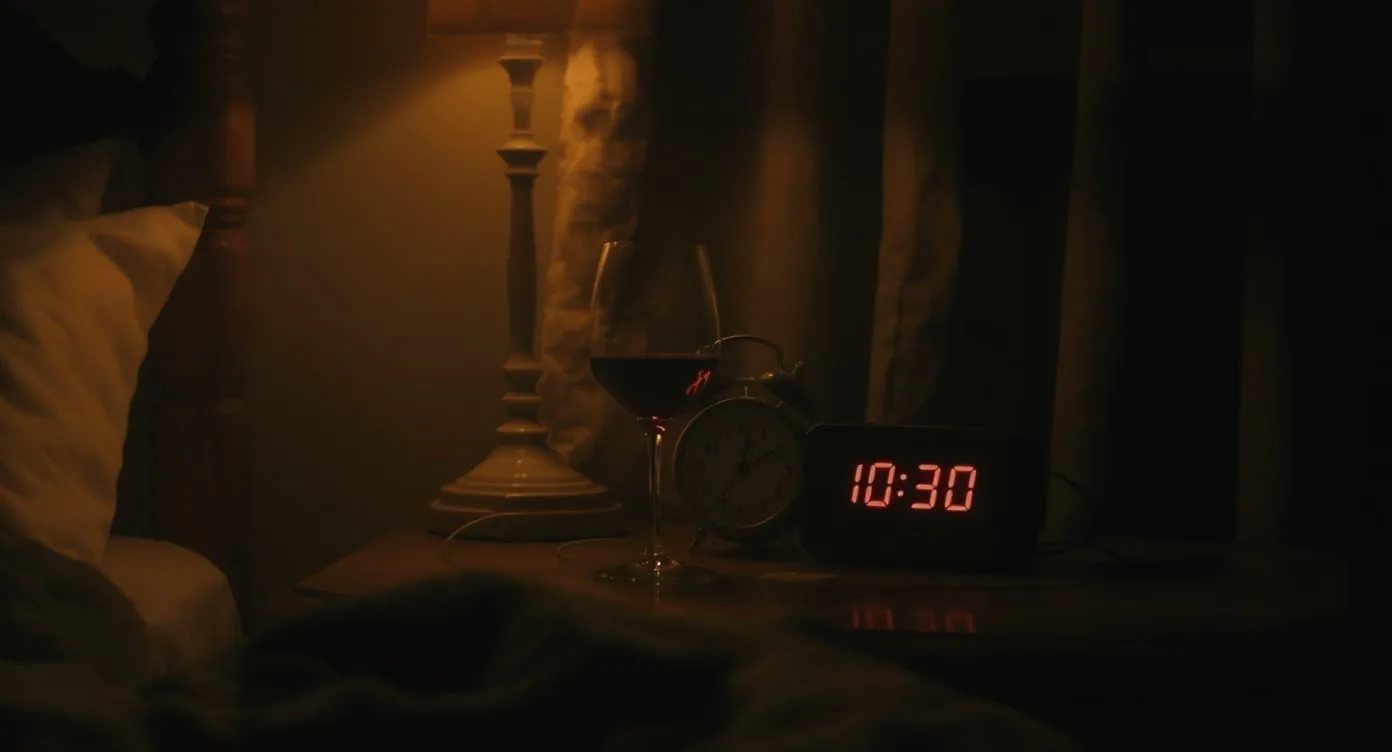
Alcohol is the world's oldest and most popular sleep aid. Roughly 20% of American adults report using alcohol to help them fall asleep. And it works — in the narrowest sense. Alcohol is a sedative, and it does reduce sleep onset latency (the time it takes to fall asleep).
The problem is everything that happens after that.
Published research is remarkably consistent: alcohol fragments the second half of the night, suppresses REM sleep, disrupts sleep architecture, and produces a pattern of sleep that looks like 7–8 hours on paper but delivers the restoration of 4–5. This guide covers exactly what happens, why, and how much is "too much" when sleep quality is what you care about.
What alcohol does to sleep, hour by hour
First half of the night: the sedation phase
Alcohol initially enhances the activity of GABA — the brain's primary inhibitory neurotransmitter — while suppressing glutamate (the primary excitatory neurotransmitter). This combination produces sedation: you feel drowsy, your muscles relax, and you fall asleep quickly.
During this phase, alcohol actually increases deep (slow-wave) sleep. This is why people who drink before bed often report sleeping "deeply" or "like a rock" for the first few hours. The subjective experience is real — for the first half of the night, alcohol does produce deeper sleep.
Second half of the night: the rebound
As your liver metabolizes the alcohol (at roughly one standard drink per hour), the sedative effect wears off. But the neurochemical story doesn't return to baseline — it rebounds. The glutamate system, which was suppressed, springs back to higher-than-normal activity. The result:
- Fragmented sleep. You cycle into lighter stages more frequently and wake more often — sometimes fully, sometimes as brief micro-arousals you don't remember.
- Reduced REM sleep. Alcohol suppresses REM in the first half of the night. In the second half, there's a REM rebound — but it's fragmented and often accompanied by vivid or disturbing dreams.
- Increased wakefulness. Many drinkers experience a characteristic 2–4 AM wakefulness that corresponds to the metabolic rebound. This is the "wide awake at 3 AM after drinking" phenomenon, and it's biochemical, not psychological.
- Elevated heart rate. Alcohol metabolism raises resting heart rate during sleep — measurable on any wearable and associated with reduced recovery.
The dose-response relationship
Not all drinking affects sleep equally. The research breaks down roughly by dose:
One drink (low dose)
A single standard drink (12 oz beer, 5 oz wine, 1.5 oz spirits) consumed 3+ hours before bed has minimal measurable impact on sleep architecture for most adults. Some studies show no significant difference from baseline.
Two drinks (moderate dose)
Two drinks consumed within 2–3 hours of bed begin to show measurable effects: modest reduction in REM, slight increase in second-half fragmentation. The effects are present but manageable for most people.
Three or more drinks (high dose)
Three or more drinks produce consistent, significant disruption: deep sleep increases in the first half, but total REM is suppressed by 20–40%, second-half fragmentation increases substantially, and next-day cognitive function is impaired even after a full night in bed.
Timing matters
Alcohol consumed earlier in the evening has less impact than the same amount consumed close to bedtime, because more of it is metabolized before sleep begins. The rule of thumb from sleep researchers: finish your last drink at least 3 hours before bed, and ideally 4.
What people get wrong
"But I sleep great after a few drinks"
You fall asleep faster and sleep through the first 4 hours — that's the sedation phase, and it's real. But the second half of your night is objectively worse, and you won't necessarily notice it subjectively. Wearable data (elevated resting heart rate, reduced REM, increased restlessness) consistently tells a different story from subjective reports.
"A nightcap helps my insomnia"
Alcohol masks insomnia symptoms in the short term (faster sleep onset) while worsening the underlying problem. Over time, your brain adapts to the sedative effect, requiring more alcohol for the same result — a classic tolerance pattern. And when you stop the nightcap, rebound insomnia is often worse than the original problem. This is why sleep specialists almost universally advise against alcohol as a sleep aid.
"Wine is better than hard liquor for sleep"
The active compound is ethanol, and it affects sleep the same way regardless of the delivery vehicle. A 5-oz glass of wine contains the same ethanol as a 1.5-oz shot of whiskey. The difference is pace and volume, not the fundamental pharmacology.
What wearable data shows
If you use a sleep tracker (Oura, Whoop, Apple Watch, Fitbit), the effects of alcohol are among the most visible patterns in your data:
- Resting heart rate: elevated by 5–15+ bpm depending on dose
- HRV: suppressed, often dramatically (30–50% below baseline)
- Deep sleep: may appear increased (first half) but total is often similar or lower
- REM sleep: consistently reduced
- Sleep efficiency: lower (more time awake or in light sleep)
- Recovery score: notably lower the morning after
Many people who track sleep report that seeing the data — seeing an objectively terrible night after "just two glasses of wine" — was what finally changed their drinking-before-bed habit.
Practical guidelines
If you drink and care about sleep quality
- Stop drinking 3–4 hours before bed. This gives your liver time to metabolize most of the alcohol before sleep begins.
- Limit to 1–2 drinks. Dose-response is real — less alcohol means less disruption.
- Hydrate between drinks. Dehydration worsens next-day effects and can contribute to middle-of-the-night wakefulness.
- Don't use alcohol as a sleep aid. If you need something to fall asleep, the problem isn't a lack of alcohol — it's an underlying sleep or anxiety issue worth addressing directly.
- Track the impact. If you wear a sleep tracker, compare your metrics on drinking vs. non-drinking nights over a month. The data is usually more persuasive than any article.
If you're trying to optimize sleep
The honest recommendation from sleep researchers: avoid alcohol entirely within 3 hours of bed, and consider whether your current drinking frequency is compatible with the sleep quality you want. This isn't a moral judgment — it's a pharmacological reality.
Frequently asked
Does one glass of wine really affect sleep?+
Why do I feel more rested after drinking even though the data says my sleep was worse?+
Can I 'sleep off' a hangover?+
Is non-alcoholic beer okay before bed?+
Does alcohol tolerance reduce the sleep effects?+
References
- Ebrahim IO et al. Alcohol and sleep I: effects on normal sleep. Alcoholism: Clinical and Experimental Research, 2013.
- Colrain IM, Nicholas CL, Baker FC. Alcohol and the sleeping brain. Handbook of Clinical Neurology, 2014.
- Pietilä J et al. Acute effect of alcohol intake on cardiovascular autonomic regulation during the first hours of sleep in a large real-world sample. JMIR Mental Health, 2018.
- Thakkar MM et al. Alcohol disrupts sleep homeostasis. Alcohol, 2015.
Where to go next
Related findings.
 Protocol
Why You Wake Up at 3 AM (And What You Can Do About It)
Middle-of-the-night wake-ups have a small set of common causes — and most of them are addressable. A writer-curated look at what's really happening at 3 AM.
 Protocol
Why We Dream: What Science Actually Knows (and Doesn't)
Dreams aren't random noise. Published neuroscience points to specific functions — memory, emotion, creativity. Here's what we know and what's still a mystery.
 Protocol
Sleep for Shift Workers: A Survival Guide
Night shifts fight your biology. Here's what published research says about managing sleep when your schedule won't cooperate.