How Screen Time Actually Affects Your Sleep
It's not just blue light. Here's what the research says about phones, TVs, and laptops before bed — and what matters more than most people realize.
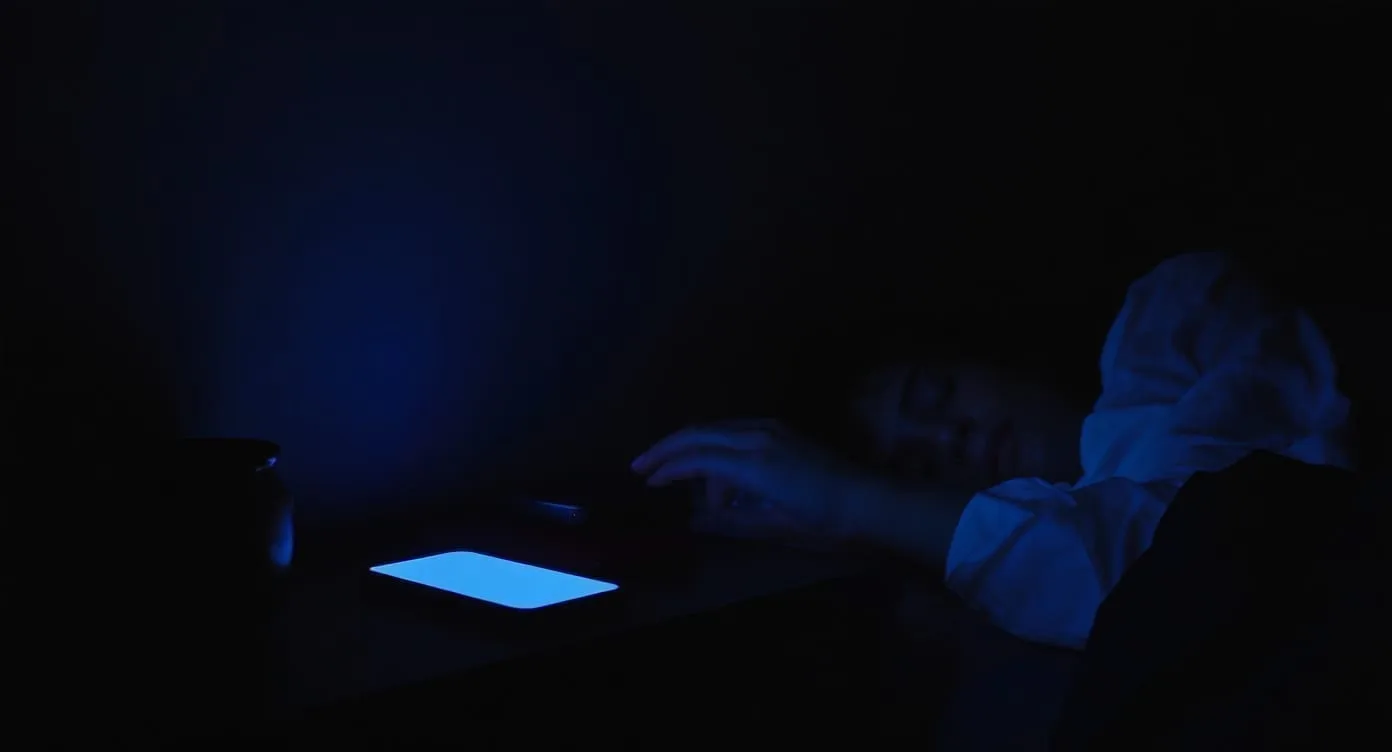
"Blue light from screens ruins your sleep" is one of the most repeated claims in the sleep-advice world. It's also one of the most oversimplified. Blue light is a factor — but it's a smaller one than most people think, and the larger effects of screen time on sleep have almost nothing to do with light wavelength.
This guide breaks down what the published research actually says about screens and sleep, separating the genuine concerns from the marketing noise, and identifying which changes actually matter.
The three ways screens affect sleep
1. Light (the smallest factor)
Screens emit short-wavelength blue light that can suppress melatonin production. This is real — but the magnitude is often overstated.
The nuance: Your phone at arm's length produces roughly 30–50 lux of illumination at your retina. A bright overhead LED ceiling light produces 300–500 lux. The research on melatonin suppression shows it's dose-dependent: brighter light suppresses more melatonin, and the threshold for meaningful suppression is higher than most phone screens at typical brightness.
A 2019 study by Grønli et al. in Sleep Medicine compared tablet use (with and without blue-light filters) before bed and found minimal difference in sleep outcomes between filtered and unfiltered screens. The authors concluded that the light component is a relatively small contributor compared to the other effects of screen use.
2. Content (the biggest factor)
The content you consume on screens is far more impactful than the light they emit. This is the finding that most blue-light marketing ignores:
Arousing content activates the sympathetic nervous system. Social media feeds, news, email, work messages, group chats, video games, and algorithmic video platforms are designed to be engaging — which means they're designed to be arousing. They trigger dopamine release, emotional responses, comparison anxiety, and cognitive engagement — all of which are the opposite of what your brain needs during the pre-sleep transition.
A 2014 meta-analysis by Carter et al. in JAMA Pediatrics found that the association between screen use and poor sleep was present across all screen types, but was strongest for interactive content (social media, gaming, messaging) and weakest for passive content (watching a movie, listening to music). The interaction — not the light — was the primary driver.
This is why "I just scroll to wind down" doesn't work. Scrolling feels passive, but your brain is actively processing novel stimuli, social comparisons, and reward signals with every swipe. Your nervous system doesn't distinguish between "important" and "casual" content — it responds to novelty and engagement regardless of your intent.
3. Time displacement (the overlooked factor)
The simplest and most underappreciated mechanism: screens push bedtime later. You intended to go to bed at 11 PM. You started watching one more video at 10:45 PM. It's now 12:15 AM.
Research consistently shows that screen use in the hour before bed is associated with later bedtimes — not because the light delayed melatonin, but because the content delayed the behavioral decision to stop and go to sleep. This effect is strongest with auto-play features (Netflix, YouTube, TikTok) that remove the natural stopping point.
What actually helps (ranked by impact)
1. Dim your overhead lights 90 minutes before bed
This has a larger effect on melatonin than anything you do with your phone. Switch off ceiling lights and use warm, low table lamps. This single change addresses the biggest light source in your environment.
2. Put your phone in another room 60 minutes before bed
This addresses all three mechanisms simultaneously: removes the light source, removes the arousing content, and removes the time-displacement trap. It's the cleanest single intervention.
If you use your phone as an alarm, replace it with a dedicated alarm clock. See our smart alarm clock roundup.
3. If you must use screens, choose passive content
Watching a familiar show on a TV across the room is significantly less disruptive than scrolling social media on a phone 12 inches from your face. The content is less novel (lower arousal), the light source is farther away (lower lux at the retina), and a TV show has a natural endpoint (the episode ends).
This is not ideal — no screens is better — but it's the harm-reduction approach for people who aren't ready to fully eliminate evening screens.
4. Use night-shift / warm-color modes
These reduce (but don't eliminate) the blue-light component of your screen. They help modestly — but they don't address content or time displacement, which are the bigger factors. Think of night-shift as a 10% improvement, not a solution.
5. Blue-blocking glasses
A reasonable additional layer if you can't control room lighting (shared spaces, hotel rooms). They filter the wavelengths that suppress melatonin, but they don't filter the dopamine, the anxiety, or the "one more scroll." See our blue-blocking glasses roundup.
The phone-in-bedroom problem
The research on keeping phones in the bedroom extends beyond sleep onset:
- Notification disruption. Even a single vibration or screen flash during the night can produce a micro-arousal that fragments sleep.
- Time-checking behavior. Waking at 3 AM and checking the time on your phone activates the screen, triggers light exposure, and often leads to "just quickly checking" messages or feeds.
- Psychological availability. Knowing the phone is within reach creates a low-level cognitive load — "something might need my attention" — that the sleeping brain doesn't fully disengage from.
What about TV?
TV is less disruptive than phones for most people, for three reasons:
- Distance. A TV 8 feet away delivers dramatically less light to your retina than a phone 12 inches away.
- Content type. TV is typically passive (watching) rather than interactive (scrolling, typing, swiping).
- Natural stopping points. An episode ends. A movie ends. The content doesn't infinite-scroll.
That said, falling asleep with the TV on is not ideal — the light and sound can fragment sleep later in the night. If you watch TV before bed, turn it off when you get into bed. A sleep timer works if you tend to fall asleep during shows.
What about e-readers?
E-ink devices (Kindle Paperwhite, Kobo) emit far less light than tablets or phones and display static, non-interactive content. Published research shows minimal sleep disruption from e-ink reader use before bed — much less than tablets or phones.
If you read before bed (which sleep researchers broadly encourage), an e-ink reader is a reasonable option. A physical book is still the gold standard for zero electronic stimulation.
Children and screens
The effects are amplified in children and adolescents:
- Higher sensitivity to light. Children's pupils are larger and their lenses are clearer, which means more light reaches the retina from the same screen.
- More interactive use. Children use screens more interactively (gaming, social media, messaging), which is the most disruptive category.
- Less self-regulation. The prefrontal cortex — responsible for stopping and going to bed — is not fully developed until the mid-20s.
The American Academy of Pediatrics recommends no screens in the hour before bed for children. This is one area where the evidence is strong enough to be prescriptive.
Frequently asked
Does night mode on my phone actually help?+
Is reading on an iPad as bad as scrolling social media?+
I fall asleep to YouTube every night. Is that bad?+
My kid needs a screen for homework until 9 PM. What can I do?+
Do computer glasses from the eye doctor help with sleep?+
References
- Carter B et al. Association between portable screen-based media device access or use and sleep outcomes. JAMA Pediatrics, 2016.
- Grønli J et al. Reading from an iPad or from a book in bed: the impact on human sleep. Sleep Medicine, 2016.
- Chang AM et al. Evening use of light-emitting eReaders negatively affects sleep, circadian timing, and next-morning alertness. PNAS, 2015.
- Christensen MA et al. Direct measurements of smartphone screen-time. PLoS ONE, 2016.
Where to go next
- Best blue-blocking glasses
- Best smart alarm clocks (phone replacements)
- The perfect bedtime routine
- Best smart bulbs for sleep
- Best minimalist bedside clocks
Related findings.
 Protocol
Why You Wake Up at 3 AM (And What You Can Do About It)
Middle-of-the-night wake-ups have a small set of common causes — and most of them are addressable. A writer-curated look at what's really happening at 3 AM.
 Protocol
Why We Dream: What Science Actually Knows (and Doesn't)
Dreams aren't random noise. Published neuroscience points to specific functions — memory, emotion, creativity. Here's what we know and what's still a mystery.
 Protocol
Sleep for Shift Workers: A Survival Guide
Night shifts fight your biology. Here's what published research says about managing sleep when your schedule won't cooperate.