Best Sleeping Positions for Back Pain (and What to Avoid)
Side, back, or stomach? What spine specialists and published studies say about sleep position and back pain — plus simple pillow adjustments that help.

Back pain is one of the most common reasons people sleep poorly — and poor sleep, in turn, makes back pain worse. Published research suggests that the relationship is bidirectional: pain fragments sleep, and fragmented sleep lowers pain thresholds the next day. Breaking this cycle often starts with something simple: how you position your body at night.
This guide covers what spine specialists and published studies say about sleep position, spinal alignment, and back pain — plus practical pillow adjustments that cost nothing and often help immediately.
Why position matters
Your spine has three natural curves: cervical (neck), thoracic (mid-back), and lumbar (lower back). When you stand with good posture, these curves are in their neutral, load-balanced position. When you lie down, the goal is to maintain those curves — or at least not force them into extreme positions for 7–8 hours.
The positions that keep the spine closest to neutral tend to produce the least pain. The positions that force the spine into flexion, extension, or rotation tend to produce the most.
Ranked: best to worst for back pain
1. On your back — best overall
Back sleeping distributes your body weight most evenly and keeps the spine in its most neutral position. The mattress supports the entire posterior chain without creating lateral pressure points.
The key adjustment: Place a pillow under your knees. This takes pressure off the lumbar spine by allowing the lower back to maintain its natural curve rather than flattening against the mattress. Many back-pain sufferers report immediate relief from this single change.
Potential issue: Back sleeping can worsen snoring and sleep apnea because gravity pulls the tongue and soft palate toward the airway. If you snore heavily or have been told you stop breathing in your sleep, back sleeping may not be appropriate — talk to a doctor.
2. On your side — best for most people
Side sleeping is the most common position and is generally well-tolerated for back pain when the alignment is right. The spine stays relatively straight if the pillow height matches the shoulder-to-head distance.
The key adjustments:
- Pillow height. Your pillow needs to be thick enough to fill the gap between your shoulder and your head. Too thin and your neck bends down; too thick and it bends up. An adjustable pillow (like the Coop Eden) lets you dial this in.
- Knee pillow. Place a pillow between your knees. This prevents the top leg from pulling the pelvis forward and rotating the lumbar spine. Dedicated knee pillows exist, but a regular pillow works fine.
- Avoid the fetal curl. Pulling your knees up tightly flexes the lumbar spine and can worsen disc-related pain. Keep your legs slightly bent but not tucked.
3. On your stomach — worst for most back pain
Stomach sleeping forces the lumbar spine into extension (arching forward) and requires you to turn your head 90 degrees to breathe, straining the cervical spine. Most spine specialists advise against it for people with back pain.
If you can't switch: Place a thin pillow under your pelvis/lower abdomen to reduce lumbar extension. Use a very flat pillow for your head — or no pillow at all — to minimize cervical strain. Some people transition away from stomach sleeping by starting on their side with a body pillow for support.
The mattress question
People with back pain often assume they need a new mattress. Sometimes they do. But the evidence is more nuanced than "firm is better":
- A 2003 study by Kovacs et al. in The Lancet found that a medium-firm mattress was associated with less back pain and disability than a firm mattress in people with chronic low back pain.
- Very soft mattresses allow the hips to sink too far, increasing lumbar flexion.
- Very firm mattresses don't conform to the body's curves, creating pressure points at the hips and shoulders.
The consensus: medium-firm is the most broadly recommended firmness for back pain, but individual response varies. A mattress topper can adjust the feel of your existing mattress without replacing it.
Pillow setup by position
| Position | Head Pillow | Body Pillow | |---|---|---| | Back | Medium loft, supports neck curve | Under knees | | Side | High loft, fills shoulder-head gap | Between knees | | Stomach | Very thin or none | Under pelvis |
When to see a doctor
Simple changes to try tonight
- Add a knee pillow — under knees (back sleeper) or between knees (side sleeper)
- Check your pillow height — your neck should be straight, not kinked up or down
- Try medium-firm — if your mattress is very soft, a firm topper may help
- Avoid stomach sleeping if you can — if you can't, use the pelvis-pillow technique
- Stretch gently before bed — 5 minutes of hip flexor and hamstring stretches can reduce nighttime tightness
A useful pillow
For side sleepers who need to dial in exact loft height, an adjustable pillow is the most reliable solution:
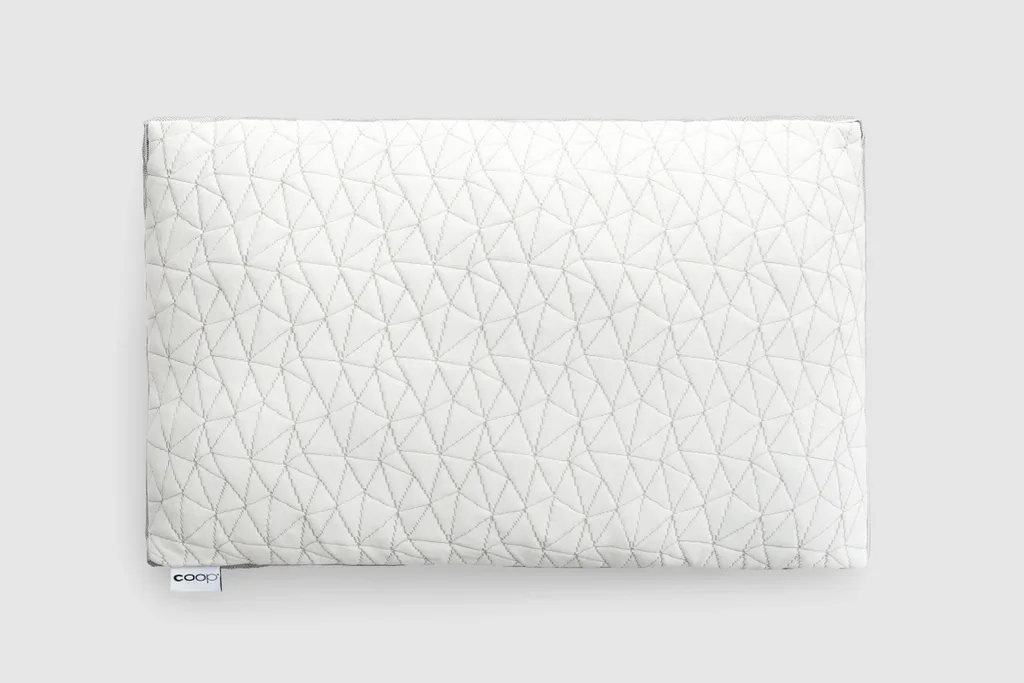
Coop Home Goods
Coop Home Goods Eden Pillow (Queen)
$96.00
Pros
- Adjustable fill — add or remove to match your loft preference
- Gel-infused memory foam for cooling
- CertiPUR-US certified foam, OEKO-TEX shell
Cons
- Off-gassing smell for first 24–48 hours
- Adjustable design requires trial and error
Frequently asked
Should I sleep on a hard floor to fix my back?+
Do I need a special 'orthopedic' pillow?+
Is it bad to switch positions during the night?+
Can sleeping position cause back pain, or just worsen it?+
What about sleeping in a recliner?+
References
- Kovacs FM et al. Effect of firmness of mattress on chronic non-specific low-back pain: randomised, double-blind, controlled, multicentre trial. The Lancet, 2003.
- Cary D et al. Identifying relationships between sleep posture and non-specific spinal symptoms in adults. BMJ Open, 2019.
- Gordon SJ, Grimmer-Somers K. Your pillow may not guarantee a good night's sleep or symptom-free waking. Physiotherapy Canada, 2011.
Where to go next
- Best pillows for sleep
- Optimal bedroom temperature guide
- 12 evidence-based sleep tips
- Best mattresses for back pain
- Best pillows for neck pain
Related findings.
 Protocol
Why You Wake Up at 3 AM (And What You Can Do About It)
Middle-of-the-night wake-ups have a small set of common causes — and most of them are addressable. A writer-curated look at what's really happening at 3 AM.
 Protocol
Why We Dream: What Science Actually Knows (and Doesn't)
Dreams aren't random noise. Published neuroscience points to specific functions — memory, emotion, creativity. Here's what we know and what's still a mystery.
 Protocol
Sleep for Shift Workers: A Survival Guide
Night shifts fight your biology. Here's what published research says about managing sleep when your schedule won't cooperate.