Withings Sleep Tracking Mat Review: The Tracker You Never Feel
A detailed review of the Withings Sleep Tracking Mat — under-mattress tracking, no subscription, and how it stacks up against wearable alternatives.
The Withings Sleep Tracking Mat occupies a unique niche in the consumer sleep-tracking market. It goes under your mattress, not on your wrist, not on your finger, not on your nightstand. You never charge it, never wear it, never think about it. Based on verified buyer reviews across Amazon, Best Buy, and the Withings store, this invisible approach is simultaneously the device's greatest strength and the source of its most common trade-offs.
This review covers what 1,000+ verified buyers consistently report about the Withings Sleep Tracking Mat — the accuracy, the setup experience, the long-term reliability, and the specific scenarios where this approach to sleep tracking outperforms wearables (and where it falls short).
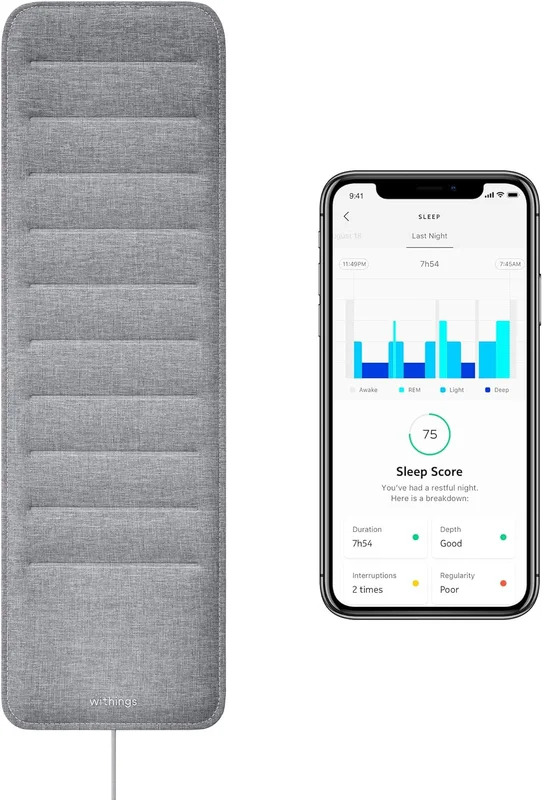
Withings
Withings Sleep Tracking Mat
$129.95
Pros
- Slides under mattress — nothing to wear
- Tracks sleep cycles, heart rate, and snoring
- No subscription required for full data
Cons
- Less accurate stage detection than Oura
- Single-zone — measures only one side of the bed
What it is
The Withings Sleep Tracking Mat is a thin sensor pad that slides under your mattress. It connects to your home WiFi and syncs data to the Withings Health Mate app on iOS or Android. Here are the key specs:
- Form factor: Thin fabric strip, roughly 25 x 7 inches, placed under the mattress at chest level
- Sensors: Pneumatic sensor detecting pressure changes from breathing and body movement
- Tracks: Sleep cycles (light, deep, REM), heart rate, snoring detection, sleep/wake timing
- Connectivity: WiFi (2.4 GHz), syncs automatically
- Power: USB-powered (plugs into a wall adapter, always on)
- Subscription: None required — all data and features included at the $129.95 purchase price
- Compatibility: Works with Apple Health, Google Fit, and IFTTT for smart-home routines
- Brand: Withings (Paris-based health-tech company, also makes the ScanWatch and Body+ scale)
What buyers consistently like
Nothing to wear, nothing to charge
This is the single most-praised aspect across every review platform. Verified buyers consistently report that the "set it and forget it" nature of the mat is what keeps them using it long-term. The pattern in reviews is clear: many owners previously used wrist-based trackers like Fitbits or Apple Watches, found the nightly charging routine annoying or the wrist discomfort bothersome, and switched to the mat specifically because they wanted tracking without any behavioral change.
A common sentiment in 4- and 5-star reviews: "I just go to bed and the data is there in the morning." Several reviewers who describe themselves as "tracking-fatigued" note that this device is the first one they've kept running for more than six months because there's literally nothing to remember to do.
No subscription required
In a market where nearly every connected device is layering on monthly fees, the Withings mat includes all features at the point of purchase. Verified buyers frequently cite this as a deciding factor, especially those who have experienced subscription fatigue from other products. Heart rate data, sleep stage breakdowns, snoring detection, and trend charts are all available in the Health Mate app with no paywall.
This stands in direct contrast to competitors like the Oura Ring ($5.99/month after the first month) and Fitbit Premium ($9.99/month for advanced sleep metrics). Over two years of ownership, the subscription-free model saves $72–$240 compared to those alternatives.
Snoring detection and smart-home integration
The snoring detection feature is frequently highlighted in positive reviews. The mat picks up vibrations associated with snoring and logs duration and intensity. Several owners report using this data to identify correlations between alcohol consumption, sleeping position, and snoring severity.
The IFTTT integration extends the mat's utility beyond tracking. Verified buyers describe automating routines like: lights off when the mat detects you're in bed, thermostat adjustment at bedtime, and coffee maker activation when the mat registers you've woken up. This home-automation angle is a differentiator that wearable trackers can't easily replicate.
The Health Mate app and ecosystem
Owners who already use other Withings products (the Body+ scale, ScanWatch, or BPM Connect blood pressure monitor) consistently praise the unified dashboard. All health data feeds into one app, creating a longitudinal view that individual devices can't provide alone. The app's sleep score is described as clear and actionable by most reviewers, with trend charts that help identify patterns over weeks and months.
Accuracy for sleep/wake detection
For the fundamental question — "did I sleep, and when?" — verified buyers generally report that the mat is reliable. It correctly identifies bedtime and wake time in the vast majority of cases, and the sleep duration numbers align with what owners know from their own experience.
What buyers consistently complain about
Sleep stage accuracy versus wearables
This is the most common criticism in detailed negative reviews. Buyers who cross-reference the Withings mat data with an Oura Ring or Apple Watch frequently note discrepancies in sleep stage classification — particularly in the split between light sleep and deep sleep. The mat tends to report different deep-sleep numbers than wrist- or finger-based devices.
This isn't surprising from a technical standpoint. Wearables with optical heart-rate sensors and accelerometers have more data points to work with than a pressure-based under-mattress sensor. The mat infers sleep stages primarily from breathing patterns and movement, while wearables add heart-rate variability and blood oxygen data. For users who want the most granular and validated sleep-stage data, wearable devices like the Oura Ring have stronger clinical validation.
Single-zone tracking only
The mat tracks one sleeper. If you share a bed, only the person sleeping on top of the mat gets tracked. You would need two mats (and two Withings accounts) for both partners, which doubles the cost and introduces potential interference complaints in a small number of reviews. Some buyers expected whole-bed tracking and were disappointed to learn about the single-zone limitation.
Partner movement interference
Related to the single-zone issue, several reviewers in shared beds report that a partner's movement can occasionally register as the tracked sleeper's activity. This is most common on softer mattresses where motion transfer is higher. Owners with firm or hybrid mattresses report fewer issues. If your mattress has strong motion isolation, this is less of a concern.
WiFi connectivity hiccups
A recurring theme in 2- and 3-star reviews is occasional WiFi disconnection. The mat requires a stable 2.4 GHz WiFi connection, and owners with mesh networks or frequent router changes sometimes experience gaps in data. When the mat loses connection, it doesn't cache data locally — the night's data is simply lost. Most reviewers who encountered this issue resolved it by assigning a static IP or moving the router closer, but it remains a frustration for a minority of buyers.
Who should buy the Withings Sleep Tracking Mat
Best for:
- People who dislike wearing anything to bed and want completely passive tracking
- Owners already in the Withings ecosystem (ScanWatch, Body+ scale) who want unified health data
- Smart-home enthusiasts who want bed occupancy to trigger automations via IFTTT
- Budget-conscious trackers who want to avoid monthly subscriptions
- Anyone who has abandoned wearable trackers due to charging fatigue or discomfort
Not great for:
- Users who need highly accurate sleep-stage classification (Oura Ring is stronger here)
- Couples who want both partners tracked without buying two units
- People with soft mattresses and active bed partners (motion interference risk)
- Anyone without stable 2.4 GHz WiFi in the bedroom
How it compares to alternatives
vs. Oura Ring Gen 3
The Oura is the more accurate device for sleep-stage tracking, backed by peer-reviewed validation studies. It also tracks daytime activity, heart-rate variability, and temperature trends — none of which the mat can do. The trade-offs: the Oura requires nightly wearing, periodic charging (every 4–7 days), and a $5.99/month subscription after the initial hardware cost (~$299). The Withings mat costs less upfront, has no subscription, and requires zero daily interaction. If accuracy is your priority, the Oura wins. If passive convenience and value are your priorities, the mat wins.
vs. Fitbit Charge 6
The Fitbit offers sleep tracking as part of a broader fitness platform. It's worn on the wrist, tracks exercise, and has a screen for notifications. The sleep data is decent but the most detailed metrics require Fitbit Premium ($9.99/month). The Withings mat is a single-purpose device: sleep only, no exercise tracking, no screen. If you want an all-in-one fitness device, the Fitbit makes sense. If you only care about sleep and don't want to wear anything, the mat is the better choice.
vs. smartphone sleep-tracking apps
Free apps like Sleep Cycle use your phone's microphone and accelerometer to track sleep. They're free or cheap, but accuracy is limited and they require your phone to be in bed or on the nightstand. The Withings mat is significantly more accurate for sleep/wake detection and doesn't require your phone in the bedroom — which aligns with the evidence-based recommendation to keep screens out of the sleep environment.
Where to buy
Frequently asked
Does the mat work with any mattress type?+
Can I feel the mat under my mattress?+
Does it track naps?+
What happens if the WiFi goes out overnight?+
How long does the mat last?+
Where to go next
- The best sleep trackers compared
- Best sleep trackers with no subscription
- Oura Ring Gen 3 detailed review
Related findings.
 Lab Report
Zinus Green Tea Memory Foam Mattress Review: The $400 Mattress Most People Actually Need
A detailed review of the Zinus 12-Inch Green Tea Memory Foam Mattress — the most-reviewed budget mattress on Amazon, and why it satisfies 80% of sleepers at 25% of the premium price.
Yogasleep Rohm Travel White Noise Machine Review: The Pocket-Sized Sleep Saver
A detailed review of the Yogasleep Rohm — portability, battery life, sound quality, and how it compares to plug-in alternatives.
 Lab Report
Yogasleep Dohm Review: The 60-Year-Old Design That Still Wins
A detailed review of the Yogasleep Dohm — why a real-fan noise machine from 1962 still outsells digital alternatives, and who it's for.