Philips SmartSleep Wake-Up Light HF3520 Review: The Original Sunrise Alarm
A detailed review of the Philips SmartSleep Wake-Up Light HF3520 — 30-minute sunrise simulation, natural sounds, and whether it's still worth the premium.
The Philips SmartSleep Wake-Up Light HF3520 is the product that largely created the consumer sunrise alarm category. It has been on the market in various iterations for over a decade, and the HF3520 remains one of the most-reviewed models in the category. With thousands of verified buyer reviews across Amazon and major retailers, the consensus is clear — and so are the limitations.
This review covers what verified buyers consistently report about the Philips SmartSleep HF3520 across all major retail platforms. The sunrise effectiveness, the sound options, the long-term durability, and the question every prospective buyer asks: is a dedicated sunrise alarm worth $170 when your phone can set an alarm for free?
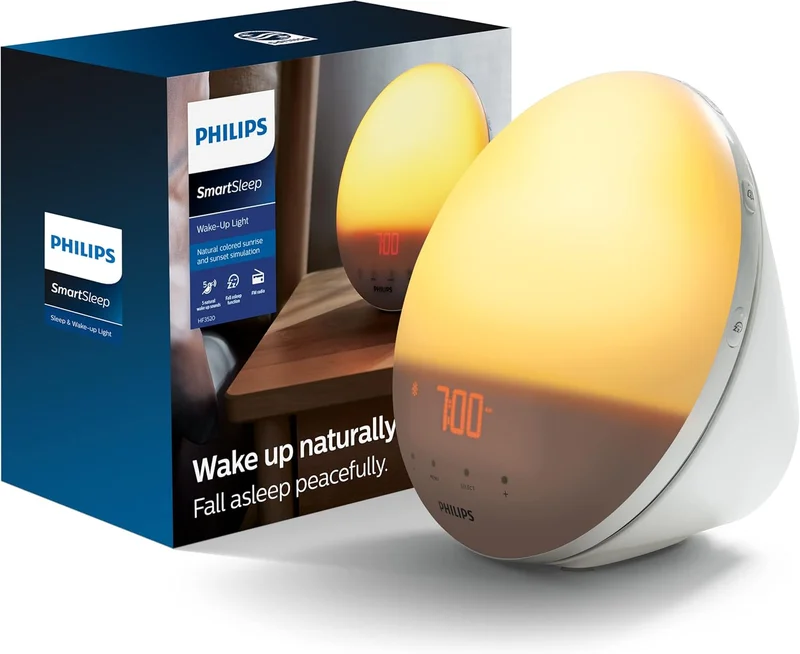
Philips
Philips SmartSleep Wake-Up Light HF3520
$169.95
Pros
- 30-minute gradual sunrise simulation
- Multiple natural wake-up sounds plus FM radio
- Doubles as a bedside lamp with adjustable warm light
Cons
- Premium price for a single-purpose device
- No app or routine programming like the Hatch
What it is
The HF3520 is a bedside lamp with a built-in alarm clock that simulates a natural sunrise before your alarm time. Key specs:
- Sunrise simulation: Light gradually increases over 20 or 30 minutes before the alarm time, progressing from deep red through orange to bright yellow-white
- Brightness levels: 20 settings, from a dim nightlight glow to full room-filling brightness
- Alarm sounds: 5 built-in natural wake-up sounds (birds, forest, ocean, piano, wind chimes) plus FM radio
- Sunset simulation: Reverse process — light gradually dims over 20 or 30 minutes for falling asleep
- Display: Digital clock face with adjustable brightness (dimmable to off)
- Power: AC powered (wall outlet only, no battery backup)
- Size: Roughly 7.5 x 7.5 x 5 inches — dome-shaped
- Price: $169.95
- Brand: Philips (Signify), leveraging decades of lighting R&D
The core concept is grounded in research: the human circadian system responds to gradually increasing light intensity in the pre-dawn hours by suppressing melatonin and initiating cortisol release. This natural wake-up process is what an abrupt phone alarm bypasses. The HF3520 aims to re-create it artificially.
What buyers consistently like
The sunrise wake-up experience
This is the reason people buy the product, and it is overwhelmingly the most-praised feature in verified reviews. Buyers describe the experience of waking to gradually increasing light as fundamentally different from waking to sound alone. Common phrases across hundreds of reviews: "I wake up before the alarm even goes off," "no more morning grogginess," and "I didn't believe it would work but it does."
The 30-minute sunrise setting is the most commonly used, based on review mentions. The light starts as a barely perceptible deep red — visible if you open your eyes but not bright enough to wake most sleepers — and progresses through orange and warm yellow to a bright white that fills the room. By the time the alarm tone fires, many owners report being already partially awake and in a lighter sleep stage.
Verified buyers in northern climates (Scandinavia, Canada, northern US) consistently describe this as a transformative winter product. When sunrise doesn't arrive until 8 or 9 AM, waking at 6 AM in total darkness is genuinely difficult for many people. The artificial sunrise fills that gap.
Simplicity of operation
Unlike app-connected devices like the Hatch Restore 2, the HF3520 is fully self-contained. There is no app, no WiFi, no account creation, no firmware updates. You set the time, pick your sunrise duration and alarm sound, and it runs. Verified buyers who value simplicity frequently contrast this favorably with smart devices that require phone interaction.
Multiple long-term reviewers (3+ years of ownership) note that the device has never failed to fire an alarm or sunrise. This reliability is mentioned repeatedly in reviews and stands as one of the key advantages of a dedicated, non-connected device.
The sunset wind-down feature
The reverse function — a gradual dimming over 20–30 minutes — is frequently cited as an unexpectedly useful feature. Buyers describe using it as a "lights out" routine: set the sunset, start reading, and the light gradually fades to zero without requiring you to get up and hit a switch. Several reviewers note that this simple cue has improved their consistency in actually getting to bed on time.
Sound quality for a clock
The five built-in sounds are described as "pleasant" and "natural-sounding" by the majority of reviewers. The bird sounds are the most popular based on review frequency. The FM radio option is useful for buyers who prefer waking to music or news. Sound quality won't match a dedicated speaker, but for alarm purposes, verified buyers consistently rate it as adequate and significantly less jarring than a phone alarm.
Doubles as a bedside lamp
The 20 brightness levels make the HF3520 functional as a regular bedside reading lamp. At full brightness, it illuminates enough for comfortable reading. At low levels, it works as a nightlight. This dual-purpose nature is valued by buyers who don't want to add a device to their nightstand — the HF3520 replaces both their lamp and their alarm clock.
What buyers consistently complain about
Price for a single-purpose device
At $169.95, the HF3520 is a significant investment for what is essentially an alarm clock with a light. This is the most common point raised in 3-star reviews — buyers who like the product but feel the price is hard to justify. The comparison point that comes up most often: budget sunrise alarms from brands like JALL offer similar core functionality for $135 less.
The counterpoint made by long-term 5-star reviewers: the Philips light quality, color progression, and reliability justify the premium, and the device lasts for years. Whether the premium matters depends on your budget and how much you value the quality of the light ramp.
No app or smart-home integration
This is both a strength and a weakness, depending on the buyer. For smart-home users who want their alarm to integrate with other devices (thermostats, lights, coffee makers), the HF3520 is an island. It can't be triggered by routines, can't be controlled remotely, and can't be adjusted from your phone. Buyers who want these capabilities consistently point to the Hatch Restore 2 as the better option.
No battery backup
If the power goes out overnight, the clock resets and your alarm doesn't fire. This is mentioned in negative reviews frequently enough to be a real concern. The device has no battery backup for the clock or alarm function. Buyers in areas with unreliable power or frequent storms note this as a meaningful limitation.
Limited alarm customization
You get two alarm presets — that's it. There's no option for different alarms on weekdays versus weekends unless you manually change the settings each time. Smart alarm clocks handle this automatically. For buyers with variable schedules, this manual process is a daily friction point.
Who should buy the Philips SmartSleep HF3520
Best for:
- People who want a proven sunrise wake-up experience without app complexity or subscriptions
- Buyers in dark-winter climates who struggle with early-morning waking
- Anyone who values device simplicity — no WiFi, no accounts, no updates
- People who want a combined bedside lamp and alarm clock in one device
- Users who dislike wearable sleep tech and prefer environmental solutions
Not great for:
- Smart-home enthusiasts who want app control and device integration
- Budget-conscious buyers who can get 80% of the experience for half the price
- People with variable weekday/weekend schedules who need flexible alarm programming
- Anyone who needs battery backup for reliable alarm function
How it compares to alternatives
vs. Hatch Restore 2
The Hatch is the modern, connected alternative. It adds app-based routines, a sound machine library, guided meditations, and smart-home integration. It also costs $30 more and layers on a subscription for premium content. The Philips has a better light (higher peak brightness, more natural color progression, based on verified buyer comparisons) but lacks connectivity. If you want a simple, reliable sunrise light, the Philips wins on light quality. If you want an integrated bedside system with app control, the Hatch is the better fit.
vs. JALL Wake Up Light
The JALL offers a surprisingly capable sunrise experience at roughly $35 — about a fifth of the Philips price. Its full-screen LED is brighter than most budget picks, with 20 brightness levels and a 10-to-60-minute adjustable ramp. The Philips still has a more natural color progression and simpler controls, but the JALL packs more features (25 sounds, Bluetooth, dual alarm) at a fraction of the cost. For budget buyers who want to try sunrise waking without a big investment, the JALL is the obvious entry point.
vs. smart bulbs (Philips Hue, LIFX)
Smart bulbs can simulate a sunrise via app scheduling. They're more flexible (you can customize color, duration, and brightness curves) and integrate with your existing lamps. But they require more setup, depend on WiFi and a bridge (for Hue), and don't include alarm sounds. The HF3520 is the all-in-one option for people who want sunrise + sound in a single device with zero configuration complexity.
Where to buy
Frequently asked
How bright is the light at maximum?+
Can I use only the light without the alarm sound?+
Does it work for heavy sleepers?+
How long has this model been available?+
Is the sunset simulation as effective as the sunrise?+
Where to go next
- Best sunrise alarm clocks compared
- Best smart alarm clocks for sleep
- Hatch Restore 2 review (the connected alternative)
Related findings.
 Lab Report
Zinus Green Tea Memory Foam Mattress Review: The $400 Mattress Most People Actually Need
A detailed review of the Zinus 12-Inch Green Tea Memory Foam Mattress — the most-reviewed budget mattress on Amazon, and why it satisfies 80% of sleepers at 25% of the premium price.
Yogasleep Rohm Travel White Noise Machine Review: The Pocket-Sized Sleep Saver
A detailed review of the Yogasleep Rohm — portability, battery life, sound quality, and how it compares to plug-in alternatives.
 Lab Report
Yogasleep Dohm Review: The 60-Year-Old Design That Still Wins
A detailed review of the Yogasleep Dohm — why a real-fan noise machine from 1962 still outsells digital alternatives, and who it's for.