Vornado 660 Review: Whole-Room Airflow That Doubles as White Noise
A detailed review of the Vornado 660 whole room air circulator — vortex airflow, 4-speed control, white noise for sleep, and the trade-offs vs. tower fans.
The Vornado 660 Whole Room Air Circulator occupies a specific niche that makes it a recurring recommendation in sleep communities: it moves air across an entire room without pointing a direct breeze at the bed, and it produces a consistent, non-oscillating hum that many buyers describe as ideal white noise for sleep. Unlike tower fans that oscillate and create intermittent airflow, the Vornado 660 uses a vortex circulation pattern that bounces air off walls and ceilings to create even, room-wide movement — cooling the space rather than just the person sitting in front of it.
This review covers what thousands of verified buyers consistently report about the Vornado 660's airflow performance, noise profile across its four speeds, and who should consider a different fan type instead.
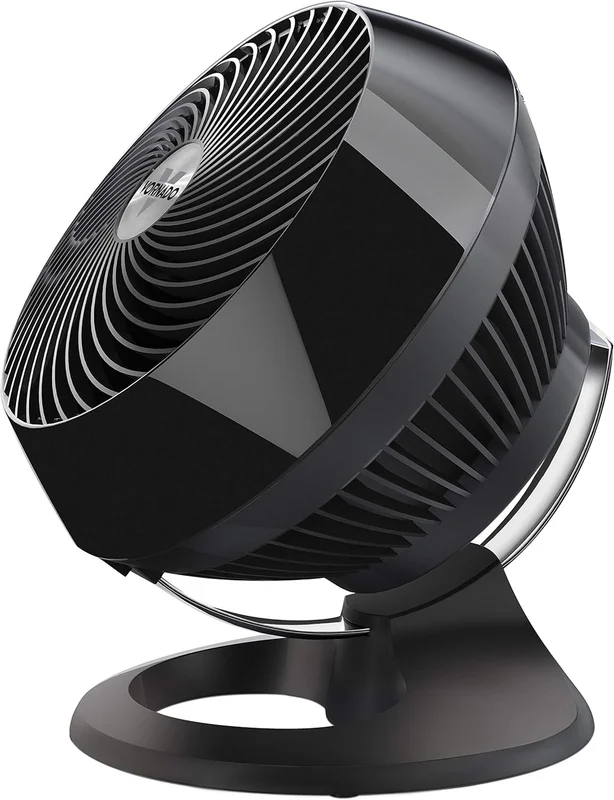
Vornado
Vornado 660 Whole Room Air Circulator
$99.99
Pros
- Vortex airflow circulates an entire bedroom
- Four speeds — gentle for sleep, powerful for cooling
- Provides white noise as a side benefit
Cons
- Audible motor on high settings
- Larger footprint than basic desk fans
What it is
The Vornado 660 is a medium-to-large floor fan with a deep-pitch blade and a spiral grill designed to produce vortex airflow. Instead of blowing a flat stream of air in one direction, the vortex pattern creates a continuous circulation loop: air moves from the fan toward the far wall, bounces off surfaces, and circulates back — creating even airflow throughout the room rather than a concentrated breeze.
The key specs:
- Airflow pattern: Vortex (whole-room circulation, no oscillation)
- Speed settings: 4 (low, medium-low, medium-high, high)
- Room coverage: Up to 100 sq ft effectively; assists in larger rooms
- Dimensions: 12.2" x 14.1" x 14.5" (larger than typical desk fans)
- Weight: ~7.5 lbs
- Cord length: 6 ft
- Price: ~$99.99
What buyers consistently like
1. Vortex airflow circulates the whole room
The defining feature and the reason the Vornado 660 exists. Rather than creating a direct breeze that cools whoever sits in front of the fan, the vortex pattern circulates air throughout the room. Verified buyers consistently describe the effect as "the whole room feels cooler" rather than "there's a breeze hitting my face." For sleep, this is a meaningful distinction — direct airflow on the face can cause dry eyes, dry throat, and disrupted sleep, while whole-room circulation reduces ambient temperature without the concentrated blast.
2. Consistent white noise for sleep
The Vornado 660 produces a steady, non-oscillating hum that many buyers purchase it specifically for. Because the fan doesn't oscillate, the sound doesn't cycle between louder and quieter phases — it's a constant, even tone. Verified buyer reviews from light sleepers and people in noisy environments consistently describe the fan's sound as "better white noise than my sound machine" on speeds 1 and 2. The low-frequency hum masks intermittent sounds (traffic, barking dogs, apartment noise) effectively because it fills the same frequency range.
3. Four speeds provide useful range
The four speed settings span from a gentle, quiet circulation on speed 1 to a powerful airflow on speed 4 that can move curtains across the room. For sleep, most buyers use speeds 1 or 2 — enough to circulate air and produce white noise without being overwhelming. Speeds 3 and 4 are used for daytime cooling or to quickly cool down a room before bed. The range is wide enough that most buyers find at least one setting that matches their preference for both airflow and noise level.
4. Build quality and durability
Vornado fans have a reputation for longevity that is consistently confirmed in verified buyer reviews. Multiple reviewers report using the same Vornado 660 for 3–5+ years of daily use without performance degradation. The motor, blade, and housing are built to a standard above typical consumer fans. At $100, the upfront cost is higher than cheap box fans or tower fans, but the per-year cost drops significantly with multi-year use.
5. No oscillation to maintain or break
Oscillating fans have a mechanical pivot that wears out over time and creates the cycling noise pattern that many sleepers find disruptive. The Vornado 660 has no oscillation mechanism — the fan body is fixed and relies on the vortex pattern to distribute air. This means one fewer moving part to fail and a sound profile that never changes during operation. Verified buyers who previously used oscillating tower fans consistently note the steady sound as an upgrade for sleep.
What buyers consistently complain about
1. Audible on high speed settings
On speeds 3 and 4, the Vornado 660 produces enough noise that it transitions from "pleasant white noise" to "noticeably loud" for most listeners. Verified reviews consistently describe speeds 3–4 as too loud for sleeping unless you're accustomed to significant background noise. This is inherent to the physics of moving large volumes of air — more airflow means more turbulence noise. Most buyers who use this fan for sleep stick exclusively to speeds 1 and 2.
2. Larger footprint than tower fans
At roughly 14 inches in each dimension, the Vornado 660 takes up more floor space than a typical tower fan. Buyers in small bedrooms or tight nightstand areas consistently mention the size as a drawback. It's not enormous, but it doesn't tuck into a corner the way a slim tower fan does. The trade-off is the more powerful airflow — the deep-pitch blade and wide housing are what enable the vortex circulation pattern.
3. No remote control
The Vornado 660 has manual controls only — a dial on the top of the unit. There's no remote control and no smart-home integration. If the fan is across the room, adjusting the speed means getting out of bed. Verified reviews from buyers who use the fan primarily for sleep consistently flag this as an annoyance, particularly for people who want to turn the fan down (or off) in the middle of the night without fully waking up. The Vornado 633DC (a different model) offers a remote, but at a higher price.
4. Cannot angle upward significantly
The tilt adjustment on the Vornado 660 is limited. Buyers who want to point the fan toward the ceiling for indirect airflow report that the maximum tilt angle is insufficient for this use case. The fan is designed to aim straight ahead or slightly upward, relying on wall-bounce rather than ceiling-bounce for circulation. For most bedroom setups this is fine, but buyers with specific ceiling-fan-like circulation preferences may find the limited tilt restricting.
Airflow and sleep temperature: why it matters
Bedroom temperature is one of the most well-established environmental factors in sleep research. The body's core temperature naturally drops by 1–2 degrees during sleep onset, and a cooler ambient environment facilitates this process. Most sleep research converges on 65–68 degrees Fahrenheit (18–20 degrees Celsius) as the optimal range for sleep.
Air circulation contributes to temperature regulation in two ways. First, moving air promotes evaporative cooling from the skin, which helps the body shed heat more efficiently. Second, circulation prevents warm air from stratifying near the ceiling while cooler air pools at floor level — a common problem in bedrooms with poor airflow that makes the sleeping surface warmer than the thermostat suggests.
Verified buyer reviews from hot sleepers consistently describe the Vornado 660 as making a perceptible difference in bedroom comfort without the direct-breeze drawbacks of traditional fans. The indirect airflow pattern means you benefit from cooler ambient air without waking up with dry eyes, a sore throat, or the sensation of wind on your face all night. For sleepers who run hot but find direct fan airflow uncomfortable, this whole-room approach addresses both problems simultaneously.
The white noise factor
A significant proportion of Vornado 660 buyers purchase it specifically for the sound rather than the airflow. The fan's steady, low-frequency hum creates broadband noise that masks intermittent environmental sounds — passing traffic, barking dogs, apartment neighbors, early-morning birds, and urban street noise.
What makes the Vornado particularly effective as a white noise source compared to dedicated sound machines is the frequency range. The fan produces genuine broadband noise across low and mid frequencies, which is difficult for electronic sound machines to replicate convincingly. Many buyer reviews compare the Vornado's sound favorably to the Yogasleep Dohm — another mechanical noise source — noting that the Vornado covers a wider frequency range and has the added benefit of actually moving air.
The non-oscillating design is critical for this use case. Oscillating fans produce a rhythmic cycling of louder-quieter-louder as the airflow sweeps past the listener. This cycling pattern can itself become a sleep disruption, particularly for light sleepers. The Vornado's fixed position and constant airflow produce a sound that never changes — no cycling, no clicking, no periodic variation. Verified buyers who switched from oscillating fans consistently describe the steady sound as a significant improvement for sleep.
On speed 1, the sound level is comparable to a quiet conversation in the next room — present but not intrusive. Speed 2 is moderately louder and provides better masking for urban noise. Speeds 3 and 4 cross the threshold into "noticeable" and "loud" for most listeners and are generally not recommended for sleeping, though a small subset of buyers in very noisy environments use speed 3 successfully.
Who should buy the Vornado 660
Best for:
- Hot sleepers who want whole-room cooling without a direct breeze on the face
- Light sleepers who want consistent, non-oscillating white noise
- Bedrooms up to 100 sq ft where even air circulation makes a perceptible temperature difference
- Buyers who value build quality and want a fan that lasts 3–5+ years
- People who find oscillating fan noise (cycling louder/quieter) disruptive during sleep
Not great for:
- Small bedrooms with limited floor space where a tower fan's slim profile is necessary
- Buyers who want remote control or smart-home integration
- People who need high-speed airflow for sleeping (speeds 3–4 are too loud for most sleepers)
- Users who want to angle the fan sharply upward for ceiling-bounce circulation
How it compares to alternatives
| Feature | Vornado 660 | Dreo Tower Fan | Honeywell TurboForce | |---|---|---|---| | Airflow type | Vortex (whole room) | Oscillating (directional) | Direct (spot cooling) | | Speed settings | 4 | 6 | 3 | | Noise on low | Low hum (steady) | Low hum (cycling) | Low hum (steady) | | Remote control | No | Yes | No | | Footprint | Large (14" x 14") | Slim (6" x 6" base) | Compact (7" x 11") | | Durability | Excellent (3–5+ years) | Good (2–3 years) | Good (2–3 years) | | Price | ~$100 | ~$70–90 | ~$30 | | White noise quality | Excellent (consistent) | Moderate (oscillation cycles) | Good (consistent, higher pitch) |
The practical breakdown: the Vornado 660 wins for whole-room circulation and consistent white noise. Tower fans win for space efficiency and remote control. The Honeywell TurboForce wins on price for direct cooling of a specific spot. For sleep specifically, the Vornado's steady sound and room-wide airflow make it the strongest choice if you have the floor space.
Where to buy
Frequently asked
Is the Vornado 660 quiet enough to sleep with?+
Does it actually cool a room or just move air around?+
How do I clean the Vornado 660?+
Can I use this with an air conditioner to reduce AC costs?+
How does this compare to a ceiling fan for sleep?+
Where to go next
Practical tips from verified buyer reviews
Several recurring recommendations from long-term Vornado 660 users are worth consolidating.
Point the fan at the far wall, not at the bed. The vortex airflow pattern works by bouncing air off surfaces to create room-wide circulation. Pointing the fan directly at the bed defeats this purpose and creates the direct-breeze effect the Vornado is designed to avoid. Aim the fan at the longest unobstructed wall in the room and let the vortex pattern distribute air naturally. Verified buyers who follow this placement advice consistently report more even room cooling than those who aim the fan at themselves.
Use speed 1 or 2 for sleep, speed 4 to pre-cool. A common pattern in detailed reviews: run the fan on speed 3 or 4 for 30–60 minutes before bed to circulate and equalize room temperature, then drop to speed 1 or 2 when you get into bed. This gives you the benefit of aggressive cooling during the setup period without the noise level that disrupts sleep.
Place on the floor for best circulation. The Vornado 660 works most effectively on the floor or a low surface, where it can push air upward and outward to create the full vortex circulation pattern. Placing it on a high shelf limits the air circulation loop and reduces its room-cooling effectiveness. Floor placement also keeps the fan stable — at 7.5 lbs, it's not likely to vibrate off a shelf, but a solid floor position eliminates any risk.
Clean the grill and blades monthly. Dust accumulation on the blades and inside the grill reduces airflow efficiency and disperses dust into the room air. Pop the front grill off (it's designed for easy removal), wipe the blades with a damp cloth, and clean the grill under running water. This takes 5 minutes and keeps the fan performing at full capacity. For allergy-prone sleepers, regular cleaning also prevents the fan from becoming a dust-distribution system.
Related findings.
 Lab Report
Zinus Green Tea Memory Foam Mattress Review: The $400 Mattress Most People Actually Need
A detailed review of the Zinus 12-Inch Green Tea Memory Foam Mattress — the most-reviewed budget mattress on Amazon, and why it satisfies 80% of sleepers at 25% of the premium price.
Yogasleep Rohm Travel White Noise Machine Review: The Pocket-Sized Sleep Saver
A detailed review of the Yogasleep Rohm — portability, battery life, sound quality, and how it compares to plug-in alternatives.
 Lab Report
Yogasleep Dohm Review: The 60-Year-Old Design That Still Wins
A detailed review of the Yogasleep Dohm — why a real-fan noise machine from 1962 still outsells digital alternatives, and who it's for.