InteVision Foam Bed Wedge Pillow Review: Elevation Therapy That Works While You Sleep
A detailed review of the InteVision Foam Bed Wedge Pillow — how it helps with reflux, snoring, and post-surgery recovery, and who benefits most.
The InteVision Foam Bed Wedge Pillow solves a specific problem: sleeping at an incline. For people with acid reflux, post-nasal drip, snoring, or post-surgical recovery needs, elevating the upper body during sleep is one of the most commonly recommended non-pharmaceutical interventions — and a wedge pillow is the simplest way to do it. The InteVision has accumulated thousands of reviews on Amazon with a consistent 4.3+ star average, and the verified buyer feedback tells a clear story: for the people who need elevation, this pillow delivers meaningful relief at a reasonable price.
This review covers what verified buyers consistently report about the InteVision Wedge Pillow — the elevation mechanics, the foam construction, the common complaints, and the specific conditions where a wedge pillow may provide the most benefit.
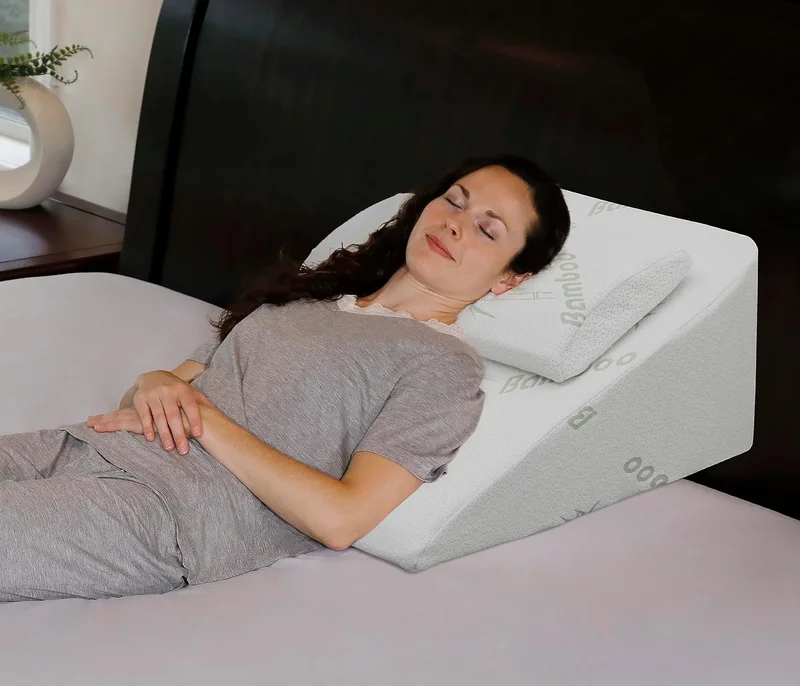
InteVision
InteVision Foam Bed Wedge Pillow
$45.99
Pros
- Helps with acid reflux, snoring, and post-surgery recovery
- Memory foam top layer for comfort
- Removable, washable bamboo cover
Cons
- Off-gassing smell on first unboxing
- Fixed height may not suit all body sizes
What it is
The InteVision Wedge Pillow is a triangular foam wedge designed to elevate the upper body at a gradual incline during sleep. It replaces stacking regular pillows (which collapse and create awkward neck angles) with a single, solid-foam structure that maintains consistent elevation throughout the night.
The construction details that matter:
- Two-layer foam construction. A base layer of standard polyurethane foam provides structure, topped with a 1.5-inch layer of memory foam for surface comfort. The combination gives you a firm, stable incline with a softer sleeping surface.
- Dimensions. Approximately 25 inches wide, 24 inches long, 12 inches high at the tallest end. The incline angle is roughly 30 degrees.
- Bamboo-derived cover. A removable, machine-washable cover made from bamboo-derived rayon. Soft to the touch, somewhat breathable, and zippered for easy removal.
- Fixed height. The 12-inch elevation is not adjustable. You cannot modify the angle or height.
- Multiple uses. Designed for sleeping, reading in bed, laptop use, and post-surgery recovery positioning.
What buyers consistently like
1. Acid reflux relief
This is the primary use case cited in positive reviews, and the owner feedback is remarkably consistent. Verified buyers with gastroesophageal reflux disease (GERD) or occasional acid reflux consistently describe a significant reduction in nighttime symptoms after switching to the InteVision wedge. The mechanism is gravity — elevating the esophagus above the stomach reduces the likelihood of acid flowing upward during sleep. For many people, this simple positional change provides more noticeable nighttime relief than other approaches alone.
Note: acid reflux is a medical condition. The InteVision wedge pillow is not a medical device and does not treat, cure, or diagnose any condition. Anyone experiencing persistent acid reflux should consult a healthcare provider for proper evaluation and treatment.
2. Snoring and breathing improvement
The second most-cited benefit in detailed reviews is improved breathing during sleep. Verified buyers — and more frequently, their sleep partners — report noticeable reductions in snoring intensity and frequency when sleeping on the wedge. Elevation opens the airway slightly by preventing the tongue and soft palate from collapsing backward as completely as they do in flat sleeping positions. This may benefit mild positional snorers, though it is not a substitute for evaluation of sleep apnea by a qualified healthcare provider.
3. Memory foam comfort layer
The 1.5-inch memory foam top layer addresses the most common complaint about budget wedge pillows: sleeping on what feels like a firm block of foam. Verified buyers consistently describe the InteVision's surface as noticeably more comfortable than single-density wedges, with the memory foam conforming to the head and upper back while the base foam maintains the incline angle. The comfort layer is thick enough to make a meaningful difference without compromising the wedge's structural stability.
4. Post-surgery recovery
A significant number of reviews come from buyers using the InteVision for post-surgical recovery — particularly after shoulder surgery, back surgery, and abdominal procedures where lying flat is painful or medically contraindicated. The consistent, stable incline allows recovery sleepers to find a comfortable elevated position without relying on pillow stacks that shift during the night. Multiple reviewers describe the wedge as essential during their first 2–4 weeks of post-surgical recovery.
5. Washable bamboo cover
The bamboo-derived cover is soft, removable, and machine washable. For a pillow that sits against bare skin for 6–8 hours per night, easy cover maintenance matters. The bamboo fabric is also mildly antimicrobial and more breathable than standard polyester covers, which partially offsets the heat retention of the memory foam layer.
What buyers consistently complain about
1. Off-gassing on arrival
This is the most frequent negative comment in detailed reviews. The memory foam layer produces a detectable chemical smell when first unboxed, and a significant number of buyers describe it as strong enough to be unpleasant. The standard recommendation across reviews: unbox the pillow 48–72 hours before you intend to sleep on it, remove the cover, and let the foam air out in a well-ventilated room. Most buyers report the smell dissipating within 2–5 days, but a small minority describe lingering odor for up to two weeks. For chemically sensitive individuals, this is a meaningful consideration.
2. Fixed height may be wrong for you
The 12-inch elevation creates a roughly 30-degree incline, which is not adjustable. This angle works well for many buyers, but detailed reviews reveal two common mismatch patterns: taller individuals (6'0"+) sometimes find the wedge too short to support the full upper torso, creating an uncomfortable bend at the lower back; and smaller individuals sometimes find the 12-inch elevation excessive, creating a too-steep angle that makes them feel like they're sliding down. There is no way to modify the height — the only option is to return the pillow and try a different height variant.
3. Sliding down during the night
Multiple reviewers describe gradually sliding down the wedge during sleep, ending up with the pillow supporting the mid-back rather than the upper body. The smooth memory foam surface has limited friction, and gravity naturally pulls the body downward on an incline. Common workarounds cited in reviews: placing a regular pillow at the base of the wedge to prevent sliding, sleeping in a fitted t-shirt for grip, or placing the wedge against the headboard so it can't move.
4. Takes up bed space
At 25 inches wide and 24 inches long, the wedge occupies a substantial portion of the sleeping surface. It doesn't move out of the way like a regular pillow — it sits on the bed as a permanent fixture whenever you need it. Partners who don't need elevation may find the wedge's presence on the bed intrusive, particularly on queen-size or smaller beds.
Who should buy the InteVision Wedge Pillow
Best for:
- People with acid reflux or GERD symptoms during sleep (consult a healthcare provider for diagnosis and treatment)
- Mild positional snorers seeking elevation-based improvement
- Post-surgery recovery where flat sleeping is uncomfortable or contraindicated
- Back sleepers who want to add a gradual incline
- Anyone currently stacking 2–3 pillows to sleep elevated (a wedge is more stable and better for neck alignment)
Not great for:
- Side sleepers (the narrow width and incline angle make side sleeping on a wedge awkward for many people)
- Stomach sleepers (incompatible with wedge positioning)
- People who are very tall (6'0"+) or very petite (the fixed height may not suit either extreme)
- Anyone sensitive to memory foam off-gassing
- People who want adjustable elevation angles
How it compares to alternatives
vs. Adjustable bed base
An adjustable bed base provides the same elevation benefit with far more flexibility — adjustable angles, powered positioning, and no pillow to deal with. However, adjustable bases cost $500–$2,000+, while the InteVision is under $50. The wedge pillow is the budget-friendly way to test whether elevation helps your symptoms before committing to a major furniture purchase.
vs. Pillow stacking
Stacking 2–3 regular pillows is free but creates a sharp bend at the neck rather than a gradual incline. This often makes neck pain worse while partially addressing reflux. The InteVision's gradual incline keeps the spine in a more neutral alignment. Verified buyers who switched from stacked pillows to a wedge consistently report better neck comfort with equivalent or better reflux relief.
vs. MedCline Reflux Relief System
The MedCline is a premium reflux-specific system ($200+) that includes a wedge with an integrated arm pocket for side sleeping. It's designed specifically for GERD and is more specialized than the InteVision. Buyers who primarily need reflux relief and sleep on their left side consistently report the MedCline as superior. The InteVision is the better choice for general-purpose elevation at a fraction of the price.
Where to buy
Frequently asked
Does a wedge pillow really help with acid reflux?+
How do I stop sliding down the wedge?+
How long does the off-gassing smell last?+
Can I sleep on my side on a wedge pillow?+
How long does the InteVision wedge last?+
Where to go next
Related findings.
 Lab Report
Zinus Green Tea Memory Foam Mattress Review: The $400 Mattress Most People Actually Need
A detailed review of the Zinus 12-Inch Green Tea Memory Foam Mattress — the most-reviewed budget mattress on Amazon, and why it satisfies 80% of sleepers at 25% of the premium price.
Yogasleep Rohm Travel White Noise Machine Review: The Pocket-Sized Sleep Saver
A detailed review of the Yogasleep Rohm — portability, battery life, sound quality, and how it compares to plug-in alternatives.
 Lab Report
Yogasleep Dohm Review: The 60-Year-Old Design That Still Wins
A detailed review of the Yogasleep Dohm — why a real-fan noise machine from 1962 still outsells digital alternatives, and who it's for.