Casper Original Pillow Review: The Pillow-in-Pillow Design That Actually Works
A detailed review of the Casper Original Pillow — how its two-layer design performs, who it suits, and where it falls short.
The Casper Original Pillow is Casper's answer to a genuinely hard problem: how do you make a pillow that's simultaneously soft on the surface and supportive underneath? Their solution is a pillow-in-pillow construction — a soft outer layer wrapped around a denser inner core — and based on verified buyer feedback across retail platforms and sleep communities, it works better than most fixed-loft alternatives at the $65 price point. The Casper won't let you adjust fill the way a Coop Eden does, but it also doesn't ask you to spend three nights tuning it. It's a one-shot design that aims for the widest comfortable middle ground.
This review synthesizes what verified buyers consistently report about the Casper Original Pillow — the comfort profile across sleep positions, the durability patterns over time, the construction decisions that explain those patterns, and the specific scenarios where this pillow excels or disappoints.
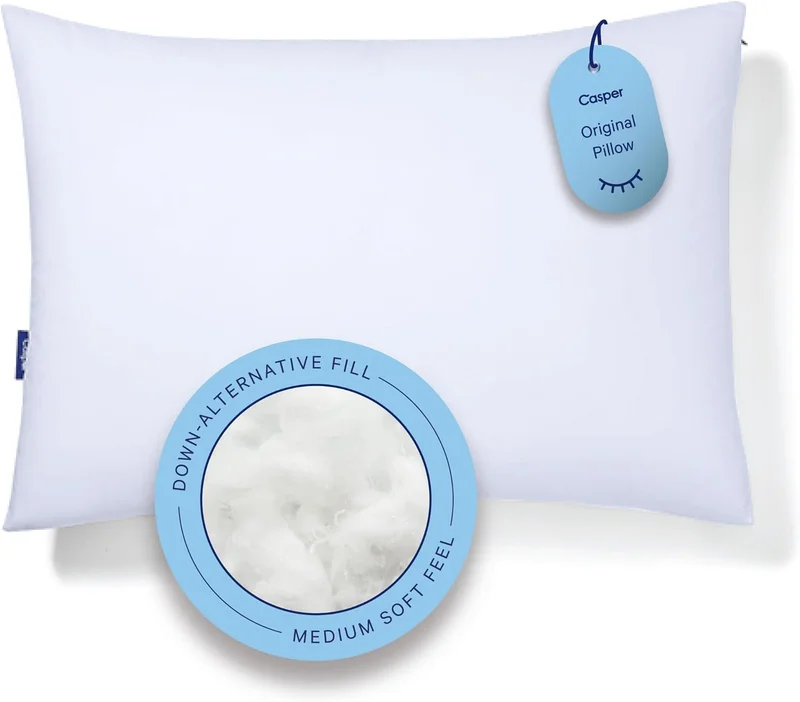
Casper
Casper Original Pillow (Standard)
$65.00
Pros
- Pillow-in-pillow design with breathable polyester microfiber
- Machine-washable cover
- Mid-range price for premium feel
Cons
- Loft may be too low for tall side sleepers
- Less customization than fully adjustable pillows
What it is
The Casper Original Pillow is a two-chamber pillow with a microfiber outer shell and a polyester-blend supportive inner core. The design concept: the outer layer provides immediate softness when your head hits the pillow, while the inner core prevents you from compressing through to the mattress.
The construction details that matter:
- Pillow-in-pillow design. Two distinct layers — a soft, fluffy outer chamber and a firmer inner pillow. This is different from shredded fill (Coop) or solid foam (Tempur-Pedic) approaches.
- Machine-washable outer cover. The cotton percale cover zips off and goes in the washing machine. The pillow itself is spot-clean only.
- Low-to-medium loft. The Casper is designed to sit lower than most memory foam pillows, which makes it more versatile for combination sleepers who shift positions.
- Standard and King sizes. Two size options, each sold individually (not as a 2-pack).
- Percale cotton cover. A crisp, breathable weave that sleeps cooler than sateen alternatives.
What buyers consistently like
1. The two-layer feel
The defining buyer experience, cited in the majority of positive reviews, is the sensation of sinking into softness and then hitting a supportive layer underneath. Verified buyers describe it as "the feel of a down pillow with actual support" or "soft without going flat." The two-chamber design genuinely delivers a different feel from single-layer pillows — it's the closest a fixed-loft pillow gets to having two loft settings in one product.
2. Combination sleeper versatility
Back-to-side combination sleepers consistently report the Casper as one of the few pillows that works in multiple positions without needing adjustment. The low-to-medium loft is low enough for comfortable back sleeping but provides enough support that side sleeping doesn't collapse the pillow entirely. This is the Casper's competitive advantage over higher-loft pillows that work for side sleeping but feel uncomfortably tall for back sleeping.
3. Breathability
The percale cotton cover and microfiber fill combination consistently earns positive marks from reviewers concerned about heat. The Casper isn't a dedicated cooling pillow with phase-change materials, but detailed reviews from warm sleepers describe it as "noticeably cooler than my old memory foam" and "doesn't trap heat the way solid foam does." The breathable construction is a meaningful difference from denser alternatives.
4. Build quality and aesthetics
Casper's brand premium shows in the details. The cover fabric, the stitching, the zipper quality, and the packaging are all consistently described as above-average in buyer reviews. For people who care about the craftsmanship and visual quality of their bedding, the Casper delivers a premium feel that matches the mid-range price point.
5. No break-in period or off-gassing
Unlike memory foam pillows that arrive compressed and chemically scented, the Casper is comfortable from the moment you unbox it. No off-gassing smell, no waiting for the foam to expand, no adjustment period. Verified buyers consistently describe first-night comfort, which is a genuine practical advantage over foam-based alternatives that need 24–72 hours of airing out.
What buyers consistently complain about
1. Too low for tall side sleepers
This is the most consistent negative theme in detailed reviews. The Casper's low-to-medium loft is a deliberate design choice for versatility, but it creates a problem for taller side sleepers (roughly 5'10" and above) with broader shoulders. The gap between shoulder and head is simply too large for the Casper to fill properly, and the inner core — while supportive — doesn't add enough height. Tall side sleepers frequently report folding the pillow or stacking it with a second pillow, which defeats the purpose of the design.
2. Not adjustable
The two-chamber construction is sealed. You cannot add fill to increase loft, remove fill to decrease it, or redistribute material within the pillow. If the shipped loft doesn't match your body geometry, your options are to return it or live with it. At $65, the lack of adjustability feels more significant than it does at the Beckham's $20 price point.
3. Inner pillow shifts
A minority of reviewers report that the inner pillow can shift position within the outer chamber during the night, creating uneven support. This seems to be more common in the King size, where the inner pillow has more room to move. Most owners don't report this issue, but when it occurs, it's frustrating enough to warrant mention.
4. Durability plateau at 12–18 months
The outer layer's softness gradually diminishes as the microfiber fill compresses. Verified reviews from long-term owners (12+ months) consistently describe a pattern where the outer layer feels less distinctly soft and the pillow begins to feel more like a single-layer product. The pillow remains usable but loses the premium two-layer feel that justified the original purchase price.
Who should buy the Casper Original Pillow
Best for:
- Combination sleepers who shift between back and side positions
- Back sleepers who want soft-over-supportive feel
- Petite-to-average-build side sleepers
- People upgrading from flat, worn-out budget pillows
- Anyone who wants premium construction without the hassle of adjustable fill
- Warm sleepers who want breathability without a dedicated cooling pillow
Not great for:
- Tall side sleepers (5'10"+ with broad shoulders)
- Stomach sleepers who need very low, thin loft
- People who want the ability to customize loft precisely
- Buyers seeking maximum durability (3+ year lifespan)
- Anyone who prioritizes value-per-dollar over brand quality
How it compares to alternatives
vs. Beckham Hotel Collection
The Beckham costs roughly a third of the Casper per pillow and provides similar softness but without the supportive inner core. The Beckham is the better budget pick for back and stomach sleepers who don't need support structure. The Casper is the better choice for combination sleepers who want the two-layer feel and better construction quality.
vs. Coop Home Goods Eden Pillow
The Eden costs slightly more than the Casper but offers full loft adjustability. The Eden is the better choice for side sleepers who need precise loft control and are willing to spend a few nights tuning. The Casper is the better choice for people who want a no-fuss pillow that's comfortable out of the box across multiple sleep positions.
vs. TEMPUR-Neck Pillow
Completely different products. The TEMPUR-Neck is a solid contoured foam pillow designed for cervical support — firmer, more structured, and purpose-built for neck pain. The Casper is a soft, versatile pillow designed for general comfort. Choose the TEMPUR-Neck for specific neck support needs; choose the Casper for all-around comfort.
Where to buy
Frequently asked
Is the Casper pillow good for side sleepers?+
How do you wash the Casper Original Pillow?+
Does the Casper pillow sleep cool?+
How long does the Casper pillow last?+
Is the Casper pillow worth the price?+
Where to go next
Related findings.
 Lab Report
Zinus Green Tea Memory Foam Mattress Review: The $400 Mattress Most People Actually Need
A detailed review of the Zinus 12-Inch Green Tea Memory Foam Mattress — the most-reviewed budget mattress on Amazon, and why it satisfies 80% of sleepers at 25% of the premium price.
Yogasleep Rohm Travel White Noise Machine Review: The Pocket-Sized Sleep Saver
A detailed review of the Yogasleep Rohm — portability, battery life, sound quality, and how it compares to plug-in alternatives.
 Lab Report
Yogasleep Dohm Review: The 60-Year-Old Design That Still Wins
A detailed review of the Yogasleep Dohm — why a real-fan noise machine from 1962 still outsells digital alternatives, and who it's for.